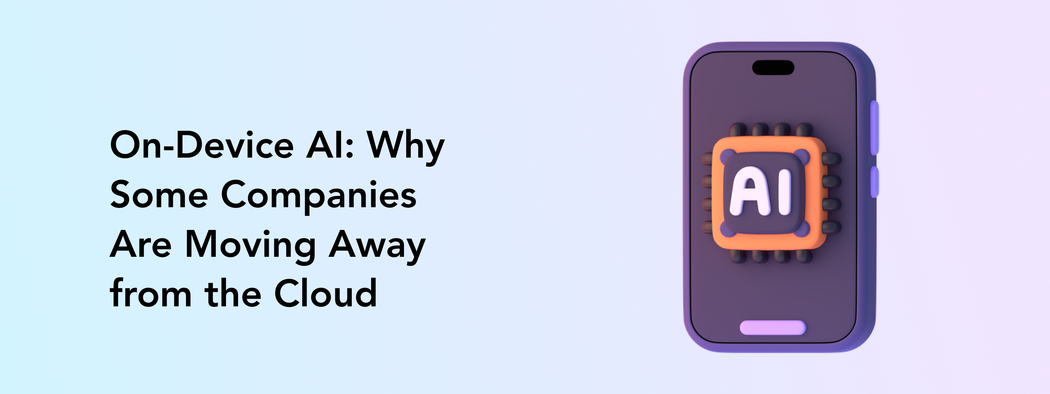
For the past three years, "AI strategy" mostly meant "which API do we call." That's changing. A growing number of product and engineering teams are pulling specific AI workloads out of the cloud and running them directly on the user's device.
Cloud remains the right choice for most large or frequently-updated models. It's a more targeted shift.
Why companies are moving to on-device AI
Four forces explain why companies are moving to on-device AI right now.
Cloud inference cost scales with every request, which gets expensive at high usage volume.
Certain experiences need latency that a network round trip can't deliver.
Privacy regulation is making on-device processing a compliance simplification for sensitive data.
And Apple and Google have both invested heavily in on-device AI platforms, lowering the engineering cost of building on-device features.
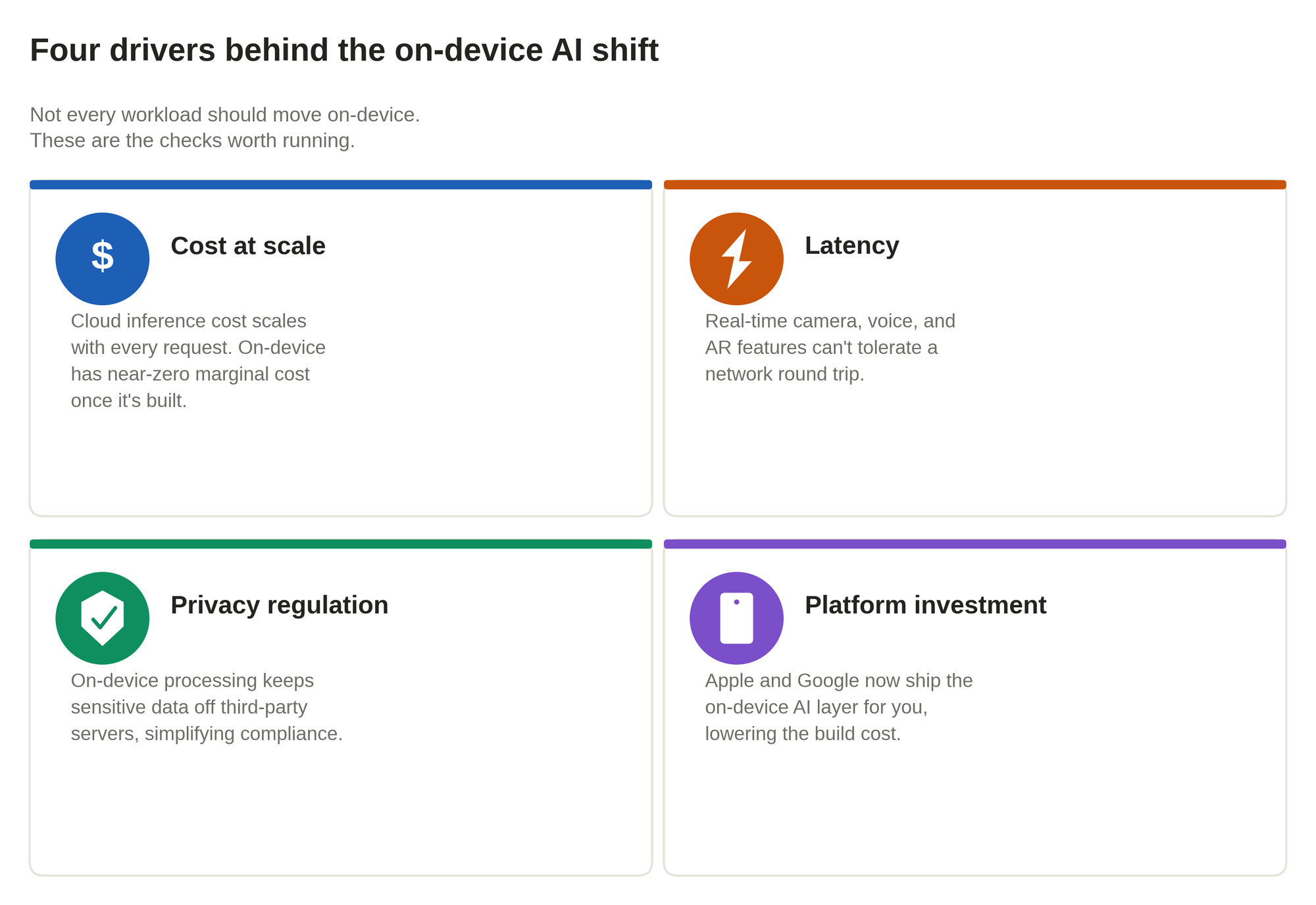
Together, these four forces are behind the broader edge AI trend for 2026: not a wholesale move away from cloud, but a more deliberate split between what runs in the cloud and what runs on the device.
At a glance, the two approaches trade off differently across the dimensions that matter most to a product decision:
| Cloud AI | On-Device AI | |
|---|---|---|
| Cost model | Pay per request. Scales linearly with usage | High upfront integration cost. Near-zero marginal cost per inference |
| Latency | Bound by network round trip | Bound only by local compute. No round trip |
| Offline support | None. Requires connectivity | Full. Works with no network at all |
| Data privacy | Data leaves the device for third-party processing | Data can stay on-device. Simpler compliance story |
| Model capability | Access to the largest, most capable models | Limited by on-device model size and hardware |
| Update cycle | Centrally patched. No client update needed | Tied to app/OS update cycle |
| Best fit | Large models, frequent updates, cross-user aggregation | High-volume, latency-sensitive, or privacy-sensitive features |
The Cost Curve That Changes at Scale
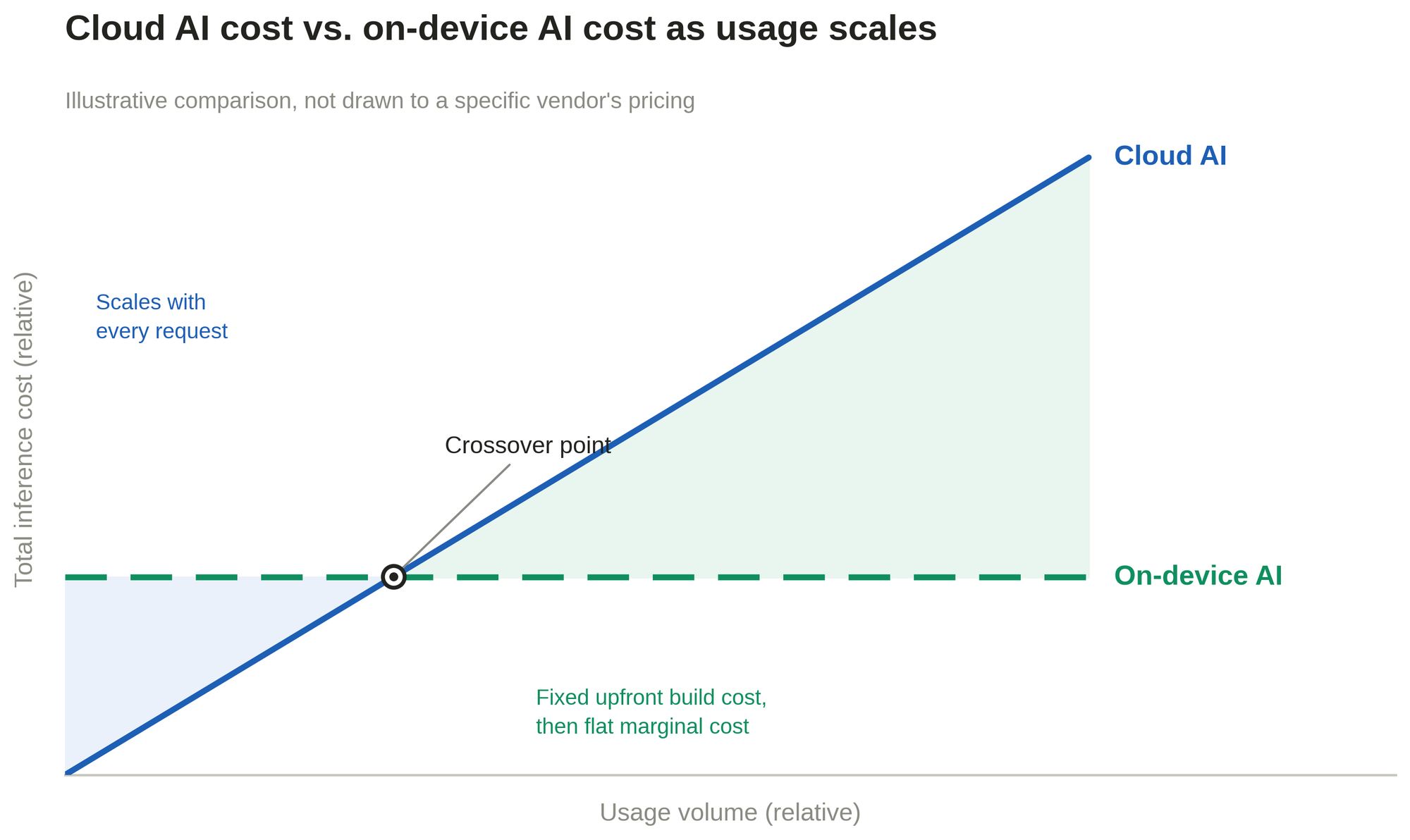
Cost is usually where the on-device AI vs cloud AI conversation starts. Cloud AI inference cost is usage-based by design. Every request costs money, and that cost scales linearly with your user base.
For a feature used occasionally, that's a fair trade. You pay for what you use, and there's no infrastructure to maintain.
But cloud AI scalability has a cost side that's easy to underestimate. For a feature used constantly, by every active user, on every session, the economics look very different. This is now one of the most visible cost lines in enterprise software budgets.
We Launched a Multi-Country Booking Platform. Here's What Broke at Scale
 Yuriy Berdnikov
Why cloud inference bills keep climbing
Enterprise generative-AI spending roughly tripled between 2024 and 2025. The cost of running a given level of model performance keeps falling, but total AI consumption is growing even faster, so bills keep climbing regardless.
Much of that growth is now concentrated in inference rather than training. Industry analysis shows inference spend overtook training spend for the first time in early 2026, and now makes up the large majority of a model's total compute cost once it's in production.
How on-device inference flips the math
On-device inference flips this cost structure, which is where most of the AI infrastructure cost optimization conversation is heading. There's real upfront engineering cost to get a model running well on-device, mainly:
- Quantization to shrink the model for local hardware
- Memory management within a mobile device's constraints
- Testing across a wide range of chipsets and OS versions
But once that work is done, the marginal cost of each additional inference is close to zero. In practice, that means:
- No per-request billing
- No scaling infrastructure to provision or maintain
- No surprise invoice when a feature suddenly goes viral
That's the core of the on-device AI cost savings argument. For a feature that fires on every session across a large user base, the crossover point where on-device becomes cheaper than cloud can arrive faster than teams expect.
That's exactly the calculation a growing share of infrastructure teams are now running explicitly when they weigh AI infrastructure cost cloud vs edge, balancing cloud's elasticity against the fixed, predictable cost of processing high-volume workloads on-device or on-premises.
Where the math doesn't hold up
The honest catch: this only pays off at meaningful scale and usage frequency. A feature used by a small fraction of users, occasionally, rarely justifies the integration cost.
The crossover point isn't a fixed number. It depends on:
- How often a feature fires per session
- How large the underlying model needs to be
- How much engineering time it takes to get an on-device version production-ready
Modeling that crossover honestly, rather than assuming cost savings will materialize automatically, is usually the first real step in this evaluation. Cost alone is rarely the deciding factor; it's usually one of several drivers pointing the same direction.
Latency-Sensitive Experiences Cloud Can't Match
Some experiences simply break if a network round trip is in the critical path. Real-time camera effects, live voice interaction, and AR overlays that need to track a moving scene all come with AI inference latency requirements that no amount of cloud infrastructure optimization fully solves.
The constraint isn't server processing time. Even a well-optimized cloud AI API's latency floor is set by the physics of sending data somewhere and getting a response back.
On-device inference removes that round trip entirely. The model runs where the data already is, so response time is bound by local compute rather than network conditions.
That also means the feature keeps working on a plane, in a basement parking garage, or on a spotty connection with no network at all. Offline AI capability demand has grown alongside this: users increasingly expect AI features to keep working when connectivity doesn't.
For UX that depends on feeling instantaneous or working reliably offline, this isn't a nice-to-have. It's the difference between a feature shipping and a feature getting cut in QA.
 Yuriy Berdnikov
Privacy Regulation Is Quietly Driving Architecture Decisions
This is the driver that gets the least attention in most on-device AI coverage, and it's arguably the most consequential for teams working with sensitive data.
Processing health data, biometric data, financial data, or children's data through a third-party cloud AI API creates a data-flow question regulators are increasingly focused on: where did that data go, who processed it, and under what legal basis.
Data privacy on-device AI is quickly becoming a real answer to that question. The regulatory backdrop behind it has gotten considerably more serious.
Data privacy regulation AI rules are accelerating, and GDPR AI on-device considerations now sit alongside a second layer of obligations. The EU AI Act reaches full applicability in August 2026, adding AI-specific obligations with penalties that stack on top of existing GDPR fines.
An organization violating both frameworks at once could face combined penalties reaching double-digit percentages of global turnover. This isn't a distant or theoretical risk.
Enforcement data already shows children's data is a top target, with several of the largest GDPR fines to date targeting exactly that category. The compliance burden is landing on budgets, too.
A meaningful share of organizations now spend well into seven figures annually on privacy, a spend level that's grown sharply in the last two years and is driven specifically by AI governance needs.
Processing data on-device sidesteps a large part of this exposure. If sensitive data never leaves the user's device, there's no third-party processor relationship to govern and no cross-border transfer to justify.
That's a meaningfully simpler compliance story for the DPIA. It doesn't eliminate the need for careful data handling; on-device processing still has to be designed and audited properly. But it removes an entire category of regulatory risk that cloud AI inherently creates.
For products in health, finance, or anything touching minors' data, this driver alone is often reason enough to evaluate on-device architecture, independent of cost or latency.
The Platforms Are Investing Heavily, and That Changes the Calculus
The on-device AI vs cloud AI decision used to be a hard sell in one direction only. On-device AI used to be a hard sell for a simple reason. Building and shipping your own on-device LLM for smartphone hardware, one that runs well across a fragmented range of chipsets, was a serious engineering lift, often out of reach for smaller teams.
That barrier has dropped substantially. Apple and Google have both moved to make on-device inference a platform-level capability rather than something every app has to build from scratch.
Apple's Foundation Models framework, introduced at WWDC25, is Apple's answer to the Apple Intelligence developer platform question: it gives developers direct Swift access to the on-device large language model that powers Apple Intelligence. It lets them build features that stay private, work offline, and run at no inference cost, using native Swift code with as little as three lines to get started.
Much of this is possible because of chip-level AI acceleration. Neural Engine AI apps on iPhone and iPad lean on Apple's dedicated silicon to run inference fast without draining the battery. Adoption has moved quickly.
Within months of release, apps across health, fitness, education, and productivity were already using the framework to build experiences that would previously have required cloud infrastructure or been impossible to build at all.
Google is building the equivalent layer into Android. Gemini Nano runs inside Android AICore, a system service that handles on-device execution, model updates, and hardware acceleration so individual apps don't have to manage any of that themselves. It's an architecture specifically designed to cut the cost and complexity of shipping large models in-app.
That hardware layer includes the Qualcomm AI Engine on mobile Snapdragon chipsets, alongside Google's own Tensor silicon and MediaTek's Dimensity line, all optimized specifically for on-device generative AI. Google has kept investing here rather than treating it as a one-off release.
Its latest Gemini Nano 4 preview targets significantly faster inference and lower battery draw than its predecessor, with a context window large enough to process much longer documents and conversations entirely on-device, without routing that data to the cloud at all.
Perpetio's Android development team tracks changes like this closely, since they shift what's realistic to build on-device from one OS release to the next.
The practical effect of both platforms' investment is that the integration cost that used to make on-device AI a hard sell has dropped sharply. That shifts a meaningful share of the cost-benefit calculation back in on-device's favor, even before you factor in latency or privacy.
Where Cloud Still Wins, and Will Keep Winning
On the on-device AI vs cloud AI question, cloud AI still wins for large or frequently-updated models, workloads that need massive context windows, and anything requiring server-side aggregation of data across many users. That's the direct answer; the reasoning behind it is more nuanced.
Why do companies use cloud AI even as on-device options mature? Mostly because cloud-based AI APIs give access to the largest, most capable models, with no ceiling on model size and no client update needed to improve them. Recommendation systems and fraud detection are good examples: their value comes from pooling signal across a whole user base, not isolating processing on one device.
On-device models are also, by necessity, smaller and less capable than the largest cloud-hosted models. Apple's on-device model runs at roughly 3 billion parameters, and Google's Nano variants are similarly compact.
That's a deliberate tradeoff for speed, privacy, and offline availability, but it's a real capability ceiling for tasks that need deep reasoning or broad world knowledge. Updating an on-device model also generally requires an app or OS update cycle, whereas a cloud model can be improved or patched centrally without touching the client at all.
For teams whose product depends on rapid iteration on model behavior, that's a meaningful advantage cloud still holds. The realistic picture, then, isn't "cloud is being replaced."
It's that a growing set of specific, latency-sensitive, privacy-sensitive, or high-volume use cases now have a genuinely better architectural answer than cloud-only. The platform-level investment from Apple and Google has made that answer easier to build than it was two years ago.
Making the Call for Your Product
The on-device AI vs cloud AI decision rarely has one right answer for a whole product. None of these four drivers (cost, latency, privacy, platform investment) is a reason to move everything on-device by default. They're a checklist for figuring out whether a specific feature or workload is a candidate.
A feature that's used constantly, needs to feel instant, touches sensitive data, or is well-suited to Apple's or Google's on-device APIs is worth a serious look. A feature that needs the largest available models, changes behavior weekly, or depends on cross-user data aggregation almost certainly doesn't belong on-device.
Getting that split right is exactly the kind of decision worth making deliberately, with an AI architecture decision consulting partner who has shipped both sides of it. Perpetio works as an AI infrastructure consulting partner and on-device AI development agency for teams making this call, and as a mobile AI development company we build the on-device and cloud pieces together rather than handing off a slide deck.
If you're weighing this tradeoff for your own product, book an AI discovery call and we'll map your specific use cases against these four drivers with you.
FAQ
Why are some companies moving AI processing on-device instead of the cloud?
Mainly four reasons: cost at scale (cloud inference pricing scales with usage, while on-device has near-zero marginal cost per inference once built), latency (some experiences can't tolerate a network round trip), privacy regulation (on-device processing simplifies compliance for sensitive data), and platform investment (Apple and Google have made on-device AI meaningfully easier to build).
Is on-device AI cheaper than cloud AI at scale?
For features used frequently across a large user base, often yes. The upfront integration cost is offset by eliminating per-request cloud inference costs. For infrequently-used features or smaller user bases, cloud usually remains cheaper.
How does data privacy regulation affect the choice between on-device and cloud AI?
Processing sensitive data (health, biometric, financial, or children's data) through cloud AI APIs creates data-transfer and third-party-processor obligations under frameworks like GDPR and the EU AI Act. On-device processing keeps that data on the user's device, simplifying, though not eliminating, the compliance picture.
What is Apple Intelligence and how does it support on-device AI?
Apple Intelligence is Apple's on-device AI system. Its Foundation Models framework gives developers direct Swift access to the on-device language model that powers it, letting apps run AI features locally, offline, and at no inference cost.
What are the limitations of on-device AI compared to cloud AI?
On-device models are smaller and less capable than the largest cloud models, updates typically require an app or OS release rather than a server-side patch, and they're a poor fit for workloads that depend on aggregating data across many users.