Healthcare has always run on a simple loop: something goes wrong, a person notices, and only then does treatment begin. This is AI preventive healthcare in practice, and it depends on AI health risk scoring models that turn raw physiological data into something a person can actually act on.
Continuous glucose monitors already do this for prediabetes, spotting patterns months before an annual blood test would. Wearable heart rate sensors have caught irregular rhythms in people who felt completely fine.
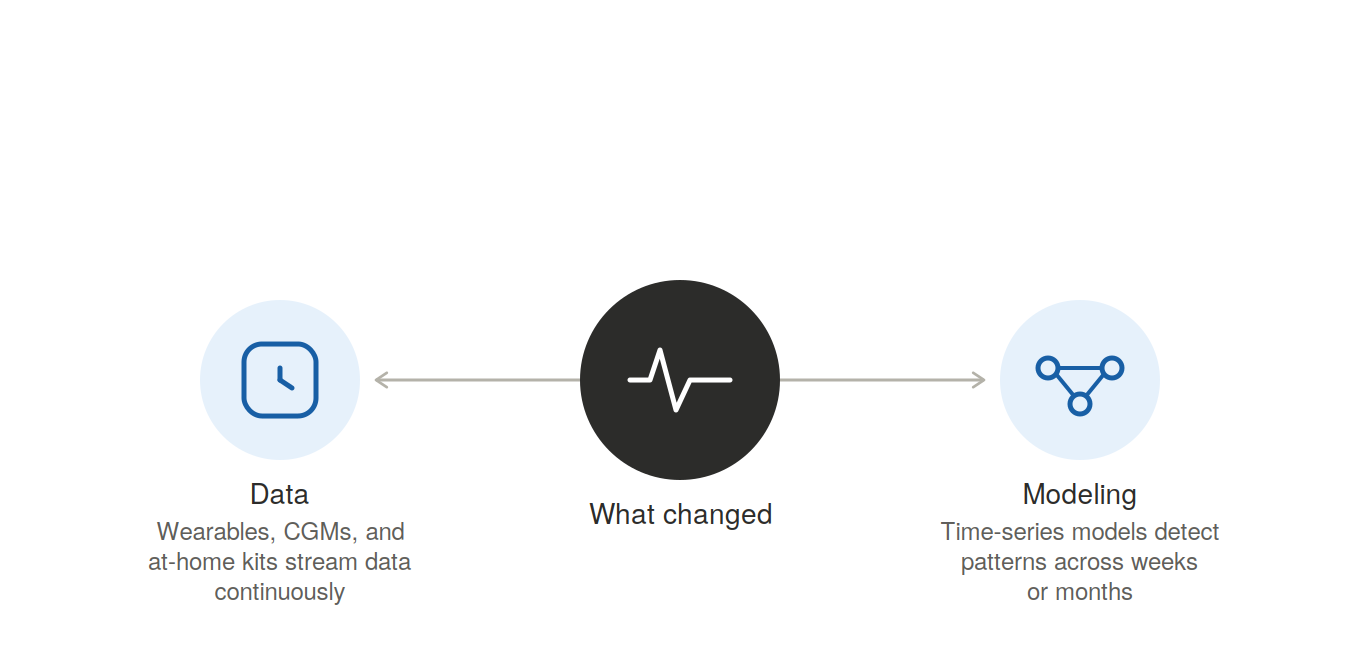
This is how the shift from reactive to preventive care works in real world: catching the earliest signal instead of waiting for a diagnosis, and it's the core idea behind predictive analytics healthcare as a category.
For healthtech founders and product leads, this is also one of the more demanding categories to build well. It touches regulated territory, sensitive data, and the weight of telling someone their risk just went up.
From Reactive to Preventive: What's Actually Changed
Understanding what is predictive health AI starts with understanding what it replaces.
Reactive care has always depended on point-in-time snapshots. A patient visits a doctor once or twice a year, gets a blood panel or an EKG, and the results reflect a single moment. Anything happening between those visits is invisible unless it becomes severe enough to send someone to urgent care.
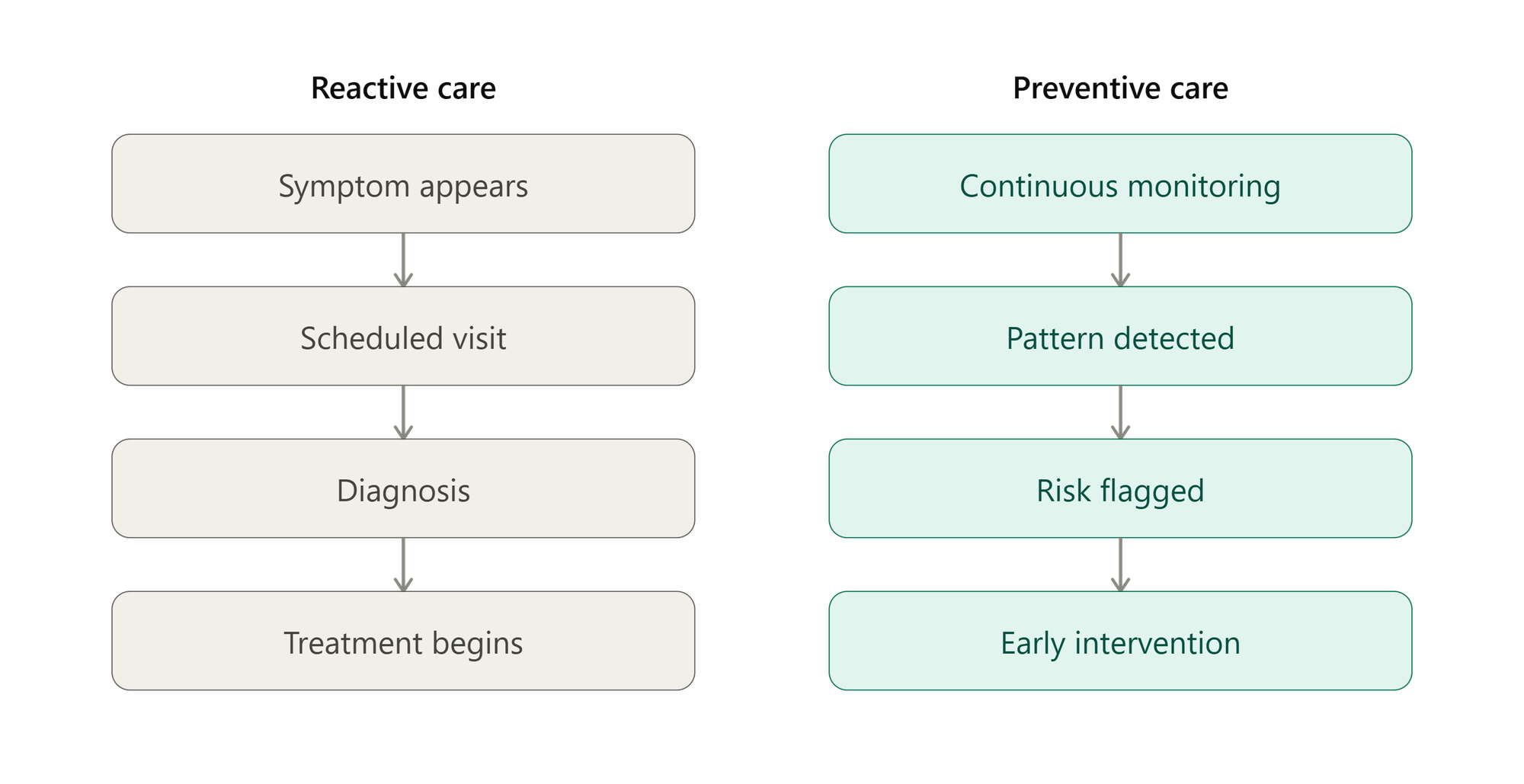
Two things changed that:
- Data. Wearables, connected glucose monitors, smart scales, and at-home diagnostic kits now generate a continuous stream of physiological data instead of a single reading twice a year.
- Modeling. Machine learning systems, particularly those built for time-series and longitudinal data, can detect patterns across weeks or months that a single snapshot would never reveal.
AI in preventive medicine is really the combination of those two shifts. It's one of the clearer digital health AI trends so far, moving from pilot programs into mainstream consumer devices.
The atrial fibrillation detection space illustrates this well. The Apple Heart Study, one of the largest wearable health studies ever run with more than 400,000 participants, found that when the watch's algorithm flagged an irregular pulse, 84% of those notifications corresponded to confirmed AFib on follow-up ECG monitoring.
A separate systematic review and meta-analysis of wrist-worn wearables, pooling nine studies and more than 1,500 participants, similarly found consistently strong diagnostic accuracy for AFib detection across device types.
These are meaningful numbers. They're also a good reminder of the limits: even a well-validated algorithm still needs a confirmatory clinical test behind it. Predictive health AI at its best doesn't replace diagnosis. It shortens the distance between a subtle risk signal and the moment a clinician gets involved.
That distinction, between flagging risk and diagnosing disease, is one of the most important things a product team can get right early. It shapes everything downstream: what data you need, how rigorously you need to validate your model, and whether your feature falls under FDA oversight at all.
What It Actually Takes to Build a Predictive Health Feature
Most consumer health apps start with a wellness framing: step counts, sleep scores, general trends. An AI risk prediction health app raises the stakes considerably, and the engineering work reflects that.
Data ingestion and normalization
Wearable data is messy by nature. A heart rate reading from an Apple Watch, a Fitbit, and a Garmin device isn't collected at the same sampling rate, with the same sensor accuracy, or in the same format.
A wearable health data pipeline, and the health data integration app layer that sits on top of it, has to:
- Normalize across device types and sampling rates
- Handle missing or noisy data gracefully
- Account for the fact that a gap in data, someone not wearing the device, can itself be meaningful
Teams building this for the first time consistently underestimate how much engineering time goes into cleaning and reconciling multi-source data before a model ever sees it.
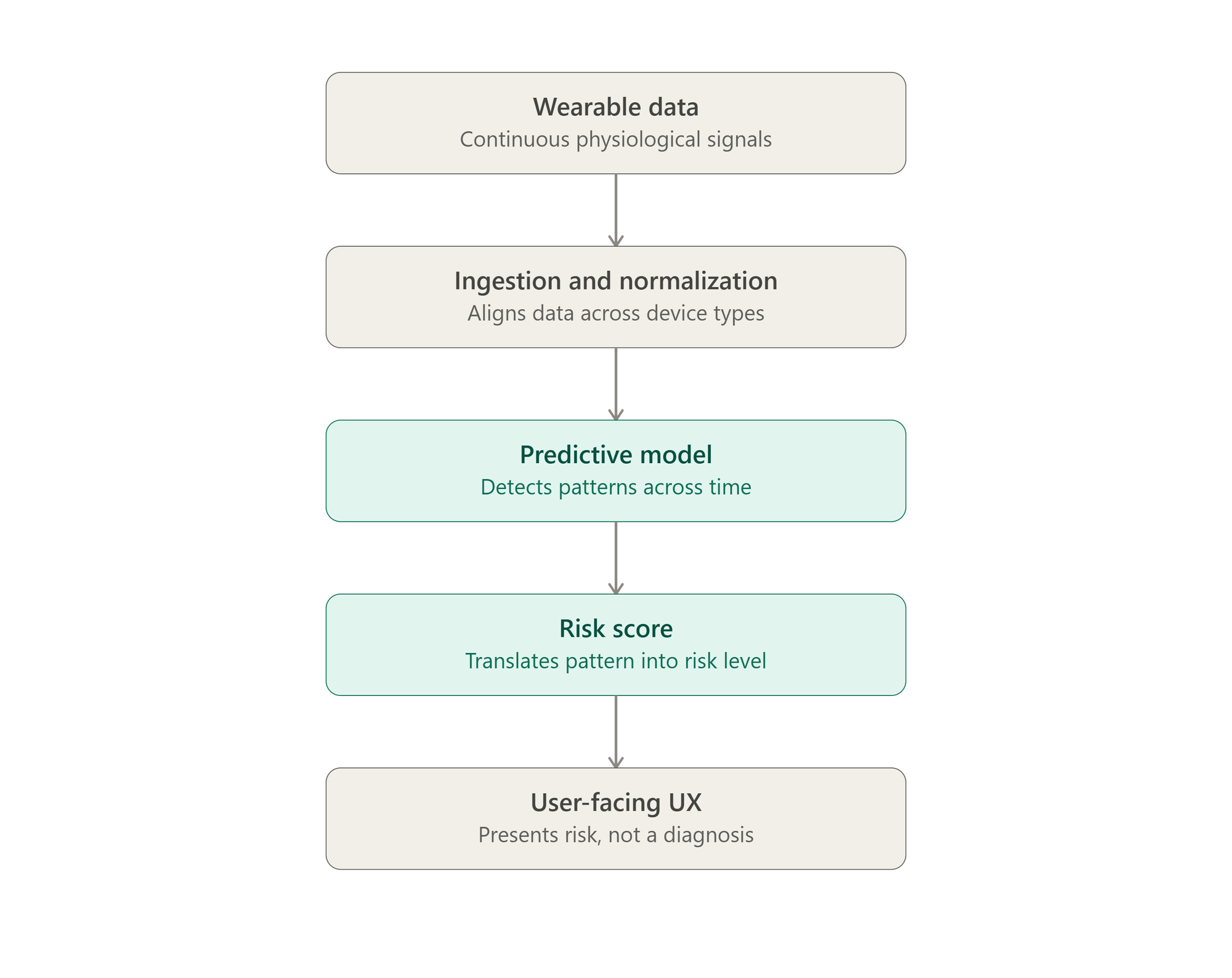
Model validation rigor
This is where a genuine gap opens up between a consumer wellness feature and something clinically meaningful. A step-count trend line can be "close enough" and still deliver value. A risk score that tells someone they may be developing a cardiovascular condition cannot.
Health data model validation for a predictive feature typically requires:
- Holding out data the model has never seen during training
- Testing performance across different demographic groups, since many clinical datasets skew toward specific populations
- Establishing a defensible relationship between the score and the actual clinical outcome it claims to predict
This is slower and more expensive than typical product validation. It should be treated as a first-class part of the roadmap rather than something to backfill after launch.
Continuous monitoring versus a single model
Because predictive health features often run on an ongoing stream of data, the underlying model needs monitoring for drift. A model trained on one population's baseline heart rate variability may perform differently as your user base grows and diversifies.
Continuous health monitoring AI systems need retraining and revalidation cadences built into the product roadmap, not just the initial build.
The gap between "this looks directionally useful in a demo" and "this is something a person should trust with a decision about their health" is almost always wider than founders expect going in. Teams that have shipped HIPAA-compliant, AI-enabled mHealth features before tend to budget for this gap explicitly rather than discovering it mid-build.
The Regulatory Line Most Teams Don't See Coming
Here's the direct answer to the question most healthtech founders eventually ask: a predictive health feature is more likely to be regulated as Software as a Medical Device when its output is used to diagnose, treat, cure, mitigate, or prevent a specific disease. It's less likely to trigger that oversight when it stays in general wellness territory, like tracking activity trends without making a clinical risk claim.
The FDA's own framework, developed with the International Medical Device Regulators Forum, defines Software as a Medical Device as software intended for one or more medical purposes that performs those purposes independently of hardware, according to the FDA's Digital Health Center of Excellence.
The practical test to walk through early:
- Does the software's output make or directly inform a specific medical claim about an individual, such as elevated stroke risk, likely AFib, or probable prediabetes? That tends to fall under SaMD oversight.
- Or does it describe a general wellness trend without a diagnostic implication? That often doesn't.
The FDA has also been actively updating its guidance in this space, specifically because traditional device regulation wasn't built for adaptive, continuously learning AI systems. In 2021, the agency published an AI/ML-based SaMD action plan, and it has continued issuing guidance on how machine learning models that change over time should be handled from a regulatory standpoint, most recently around predetermined change control plans for AI-enabled devices, per FDA's published guidance on artificial intelligence in SaMD.
Teams building anything with a continuously retrained model should read this section of FDA guidance closely. It directly addresses a question generic software regulation doesn't: what happens when the algorithm itself keeps changing after clearance.
This is general orientation, not a substitute for regulatory counsel. Whether a specific feature triggers SaMD classification depends on exact wording of claims, intended use, and how the output is presented to users. That determination should be made with a regulatory affairs specialist before a feature ships, not after.
What product teams can do early, without a lawyer in the room yet, is be deliberate about claim language internally. "May indicate elevated risk" and "detects your condition" are functionally different regulatory statements, even if they describe a similar underlying feature.
HIPAA, Data Handling, and Why This Isn't Like a Normal App Build
Even when a predictive health feature avoids SaMD classification, it is almost certainly still handling protected health information, which means HIPAA applies. This changes the shape of the build in ways that go beyond typical app security.
The HIPAA Security Rule requires administrative, physical, and technical safeguards for anything classified as electronic protected health information, and it applies to covered entities and their business associates alike, according to HHS's official Security Rule summary.
In practice, this translates into a checklist that a typical consumer app build doesn't need:
- Business Associate Agreements with every vendor that touches PHI, including cloud infrastructure, analytics, and any third-party AI or data-processing service
- Encryption for data at rest and in transit, along with strict, role-based access controls
- Comprehensive audit logging that tracks who accessed what data and when
- A documented breach notification process, since HIPAA's Breach Notification Rule requires notifying affected individuals and HHS when unsecured PHI is exposed
This is one of the areas where the build timeline and cost genuinely diverge from a standard consumer app. Retrofitting HIPAA compliance after a product has shipped is far more expensive than designing for it from the first sprint, particularly around data architecture decisions that are hard to unwind later.
The UX Risk Nobody Talks About: False Reassurance and Alarm Fatigue
Most of the conversation around predictive health AI focuses on data and model accuracy. Less attention goes to a harder problem: how do you present a risk score to a non-clinical user without causing harm in either direction?
There are two failure modes, and they pull against each other:
- False positive. Telling someone they're at elevated risk when they're not can cause real anxiety and drive unnecessary medical visits.
- False negative, or false reassurance. A design that implies "everything is fine" when the model simply didn't have enough signal can delay someone from seeking care they actually need.
Alarm fatigue is the accumulated cost of the first problem. If a risk notification fires too often or too vaguely, users start ignoring it altogether, which defeats the entire purpose of the feature.
A few design patterns consistently help teams navigate this:
- Present uncertainty honestly. A risk score framed as "may indicate elevated risk, worth discussing with a doctor" sets different expectations than one framed as a confident percentage with no context about the model's limitations.
- Route people toward a professional, not a diagnosis. The product's job is to lower the distance between "something might be off" and "a qualified person looked at it," not to replace that person. This is also where the language discipline from the regulatory section matters again: "can help flag elevated risk" is both more accurate and safer than "can detect disease."
- Separate signal strength from urgency in the interface. A borderline reading and a strongly abnormal one shouldn't look identical in the UI, or users will either overreact to noise or become numb to genuine signals.
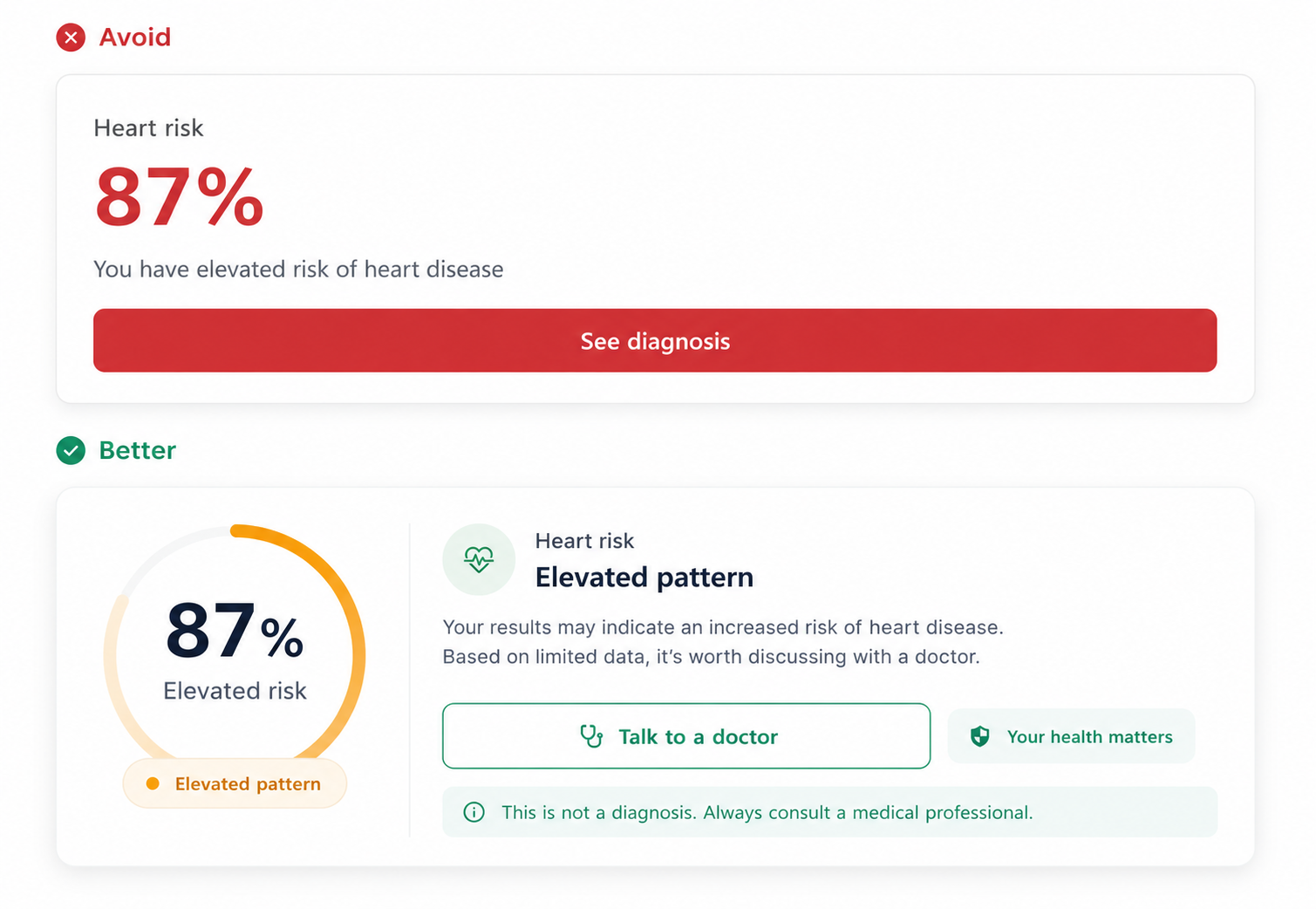
Getting this wrong is not a cosmetic UX mistake. It's the difference between a feature that builds trust over months of use and one that either scares users away or gets silently ignored.
This is also, frankly, one of the most underserved parts of the current predictive health content landscape. Most material either focuses purely on clinical validation or purely on AI capability, and skips the product design work that determines whether people actually act on what the model tells them.
Building This Right Takes an AI and Regulatory Partner, Not Just an AI Vendor
Predictive health AI sits at the intersection of three disciplines that don't usually live in the same team: data engineering, regulatory strategy, and product design for sensitive, high-stakes information.
Getting the model right isn't enough. Getting the compliance architecture and the risk communication right matters just as much, and both are easy to underestimate until a feature is already in front of real users.
This is the kind of build we approach from the product and engineering side first. Our healthcare app development services are built around exactly this intersection:
- HIPAA-aware infrastructure from day one
- AI features scoped with regulatory classification in mind
- UX decisions grounded in how people actually respond to health risk information
If you're a healthtech founder or product lead evaluating a build partner for a predictive health feature, that combination, not just AI capability on its own, is usually the difference between a feature that ships responsibly and one that creates problems six months post-launch.
Reach out if you're scoping a predictive health or AI-enabled healthtech product and want a technical and regulatory sounding board before you commit to an architecture.
FAQs
What is predictive health AI and how does it differ from traditional diagnostics?
Predictive health AI uses continuous data, typically from wearables, at-home diagnostics, and clinical records, combined with machine learning models to flag elevated health risk before symptoms appear or a formal diagnosis is made. Traditional diagnostics rely on point-in-time testing, usually during a scheduled visit, and only catch what's measurable at that single moment.
When does a health app feature count as Software as a Medical Device (SaMD)?
In general terms, a feature is more likely to be classified as SaMD when its output is intended to diagnose, treat, cure, mitigate, or prevent a specific disease or condition. Features that describe general wellness trends without making a specific medical claim are more likely to fall outside SaMD oversight, though the exact determination depends on intended use and claim language, and should be confirmed with regulatory counsel.
What does HIPAA compliance require for an AI-powered health app?
At minimum:
- Business Associate Agreements with any vendor touching protected health information
- Encryption for data at rest and in transit
- Role-based access controls
- Comprehensive audit logging
- A documented breach notification process
These requirements come from the HIPAA Security Rule and Breach Notification Rule.
How do you validate an AI health risk prediction model responsibly?
Responsible validation includes:
- Testing on data the model hasn't seen during training
- Checking performance across different demographic groups rather than a single population
- Establishing a clear, defensible link between the model's output and the clinical outcome it claims to predict
- Monitoring for model drift on an ongoing basis rather than treating validation as a one-time step before launch
What are the risks of false positives in AI-driven health predictions?
False positives can cause unnecessary anxiety and drive unwarranted medical visits. A pattern of frequent or poorly explained false positives leads to alarm fatigue, where users start ignoring notifications altogether, undermining the entire purpose of the feature. The opposite failure, false reassurance from an overly confident "all clear" signal, carries its own risk of delaying care a person actually needs.