A mortgage underwriter can spend hours checking whether one income figure matches across several documents. The $85,000 annual income on a 1003 application may need to be compared with a W-2, two bank statements, a pay stub, and an employer verification letter. The numbers may look almost identical, but small differences in pay periods, rounding, or reporting formats still need to be explained.
The CFPB recommends that borrowers prepare documents such as two years of W-2s, tax returns, recent pay stubs, and two months of bank statements, giving lenders multiple sources to verify financial information. This creates exactly the kind of repetitive cross-checking where mortgage document AI reconciliation can help.
AI can extract the relevant fields, match the same data across documents, flag discrepancies, and log why each result was accepted or escalated. Fannie Mae’s 2023 survey found that 73% of lenders cited operational efficiency as a primary motivation for adopting AI and machine learning, with document reconciliation and income verification among the use cases lenders wanted to develop. So why not try it?
In this article, we explore how AI mortgage processing automation can turn this manual reconciliation workflow into a faster, traceable process.
The 20-Document Problem: What a Mortgage File Actually Contains
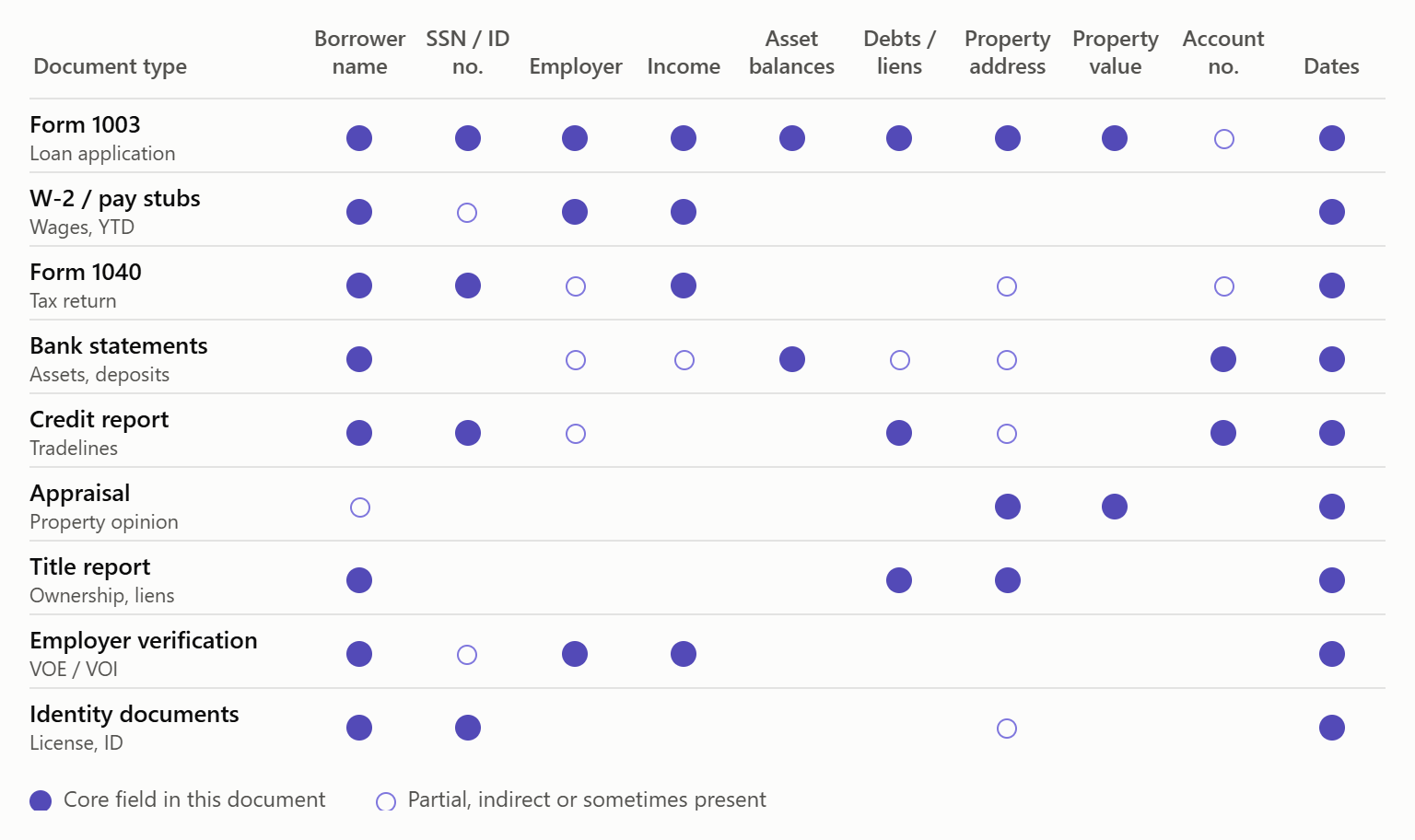
A mortgage file can contain far more than a loan application. The exact document set varies by borrower and loan, but lenders may need an application, income records, asset statements, credit information, property reports, employment verification, and identity documents before an underwriter has enough information to make a decision.
The Consumer Financial Protection Bureau’s mortgage application checklist, for example, recommends preparing recent pay stubs, two years of W-2s and tax returns, recent bank statements, and proof of identity.
A typical file may include:
- Form 1003: the main mortgage application, containing the borrower’s reported income, assets, debts, employment, and loan information. Fannie Mae requires the final 1003 to reflect the data used during underwriting, as outlined in its application package requirements.
- W-2s and pay stubs: employment and wage information, often including current earnings and year-to-date figures.
- Form 1040 tax returns: historical income and supporting schedules, particularly important for self-employed borrowers or borrowers with more complex income. Fannie Mae’s tax return and transcript documentation requirements outline when these records may be needed.
- Bank statements: balances, deposits, withdrawals, and transaction history used to verify assets and, in some cases, income.
- Credit report: credit accounts, balances, payment history, and other information relevant to the borrower’s liabilities and credit profile.
- Appraisal: information about the property and the appraiser’s opinion of its market value.
- Title report: information used to establish ownership and identify issues affecting the property title.
- Employer verification: confirmation of employment and income, which may come directly from an employer or a third-party verification provider.
- Identity documents: such as a driver’s license or other identification used to verify the borrower.
The problem is that these documents describe many of the same underlying facts in completely different ways. A borrower’s name might appear as “John R. Smith” on the 1003, “John Robert Smith” on a tax return, and in another format on an employer verification. Income can appear as an annual figure, a gross amount per pay period, year-to-date earnings, or individual deposits in a bank account.
The same issue appears with dates, employer names, account numbers, property addresses, and asset balances. One document may use a structured field, another may contain a table, while a scanned statement may require OCR before the information can even be processed. Even when two values represent the same thing, they may use different precision levels. A salary can be reported to the cent on one document and rounded to the nearest dollar on another.
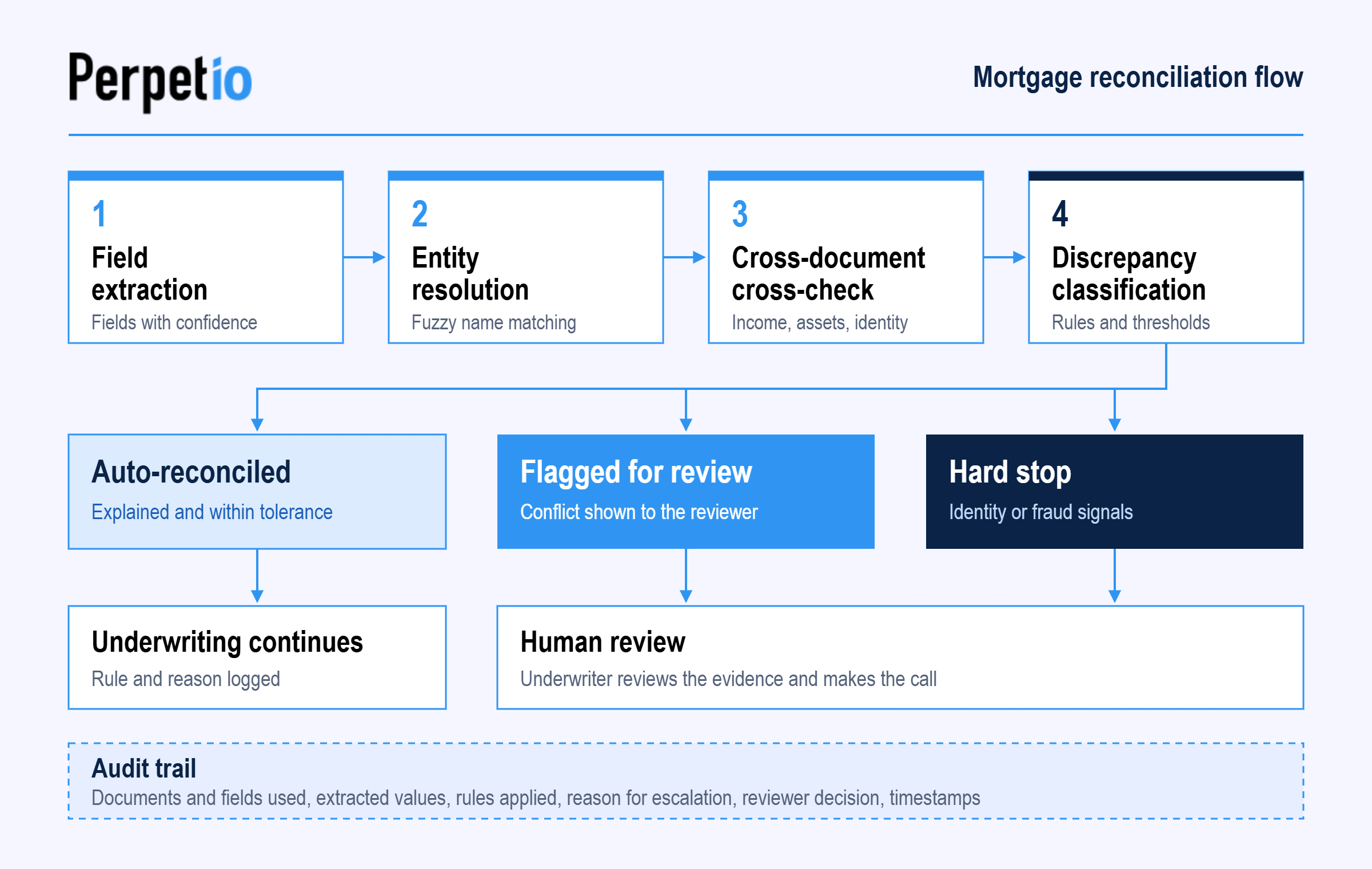
Mortgage document data extraction AI can help with this by pulling relevant fields from different document types and bringing them into a common structure. Instead of treating every file as an isolated PDF, an AI system can extract relevant fields from different document types and map them into a common structure. The next step is then to determine which values actually refer to the same borrower, employer, income source, asset, or property before comparing them.
This approach also fits into the broader mortgage software architecture. As Perpetio explains in its guide to building a custom mortgage platform, mortgage systems often need to bring information from multiple sources and workflows together rather than keeping each part of the process isolated.
The same principle applies to document processing. Extraction is only one step. Once information has been pulled from different documents, it needs to be normalized, matched, checked for inconsistencies, and passed to the right part of the underwriting workflow. Perpetio’s AI automation services cover this broader layer of connecting data and automating repetitive processes across business systems.
Document Parsing: Getting Structured Data From Every Format
Once the mortgage file is collected, the next challenge is turning documents into information that a system can actually work with. A lender may receive a standardized application, a tax return with slightly different layouts, a scanned bank statement, and a long appraisal report in the same file.
Each format needs a different approach. Treating every document as a collection of text can lose important context, such as which number belongs to which field, table, or section.
Structured forms: extract fields directly
Forms such as the 1003 are relatively predictable. The position and meaning of many fields are known in advance, which makes them a good starting point for automated extraction.
Instead of reading the document as a block of text, the system can identify individual fields such as:
- Borrower name
- Social Security number
- Employment information
- Annual income
- Loan amount
- Property address
- Assets and liabilities
The goal of PDF data extraction AI is to preserve the relationship between a label and its corresponding value. For example, “Base Salary” and “$85,000” need to remain connected even if the form contains dozens of other numbers.
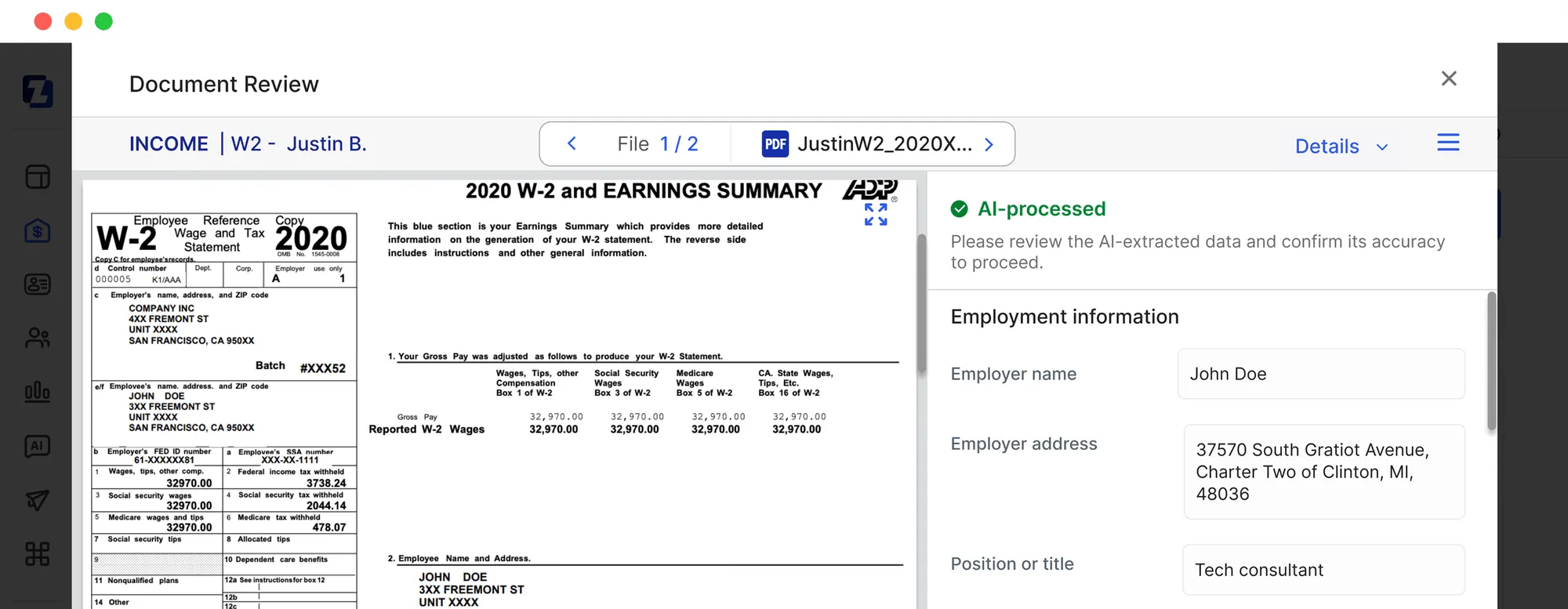
Because standardized forms have relatively consistent structures, these fields can often be extracted with a higher level of confidence than information from less predictable documents.
Semi-structured documents: account for layout variations
Tax returns are more complicated. A Form 1040 follows a standard structure, but supporting schedules, state forms, amended returns, and documents prepared by different tax professionals can vary considerably in layout.
For tax form data extraction AI, the system needs to recognize more than individual words or numbers. It needs to understand what a value represents and where it sits within the document. A number such as $120,000 could represent wages, adjusted gross income, business income, or another figure depending on its location and surrounding labels.
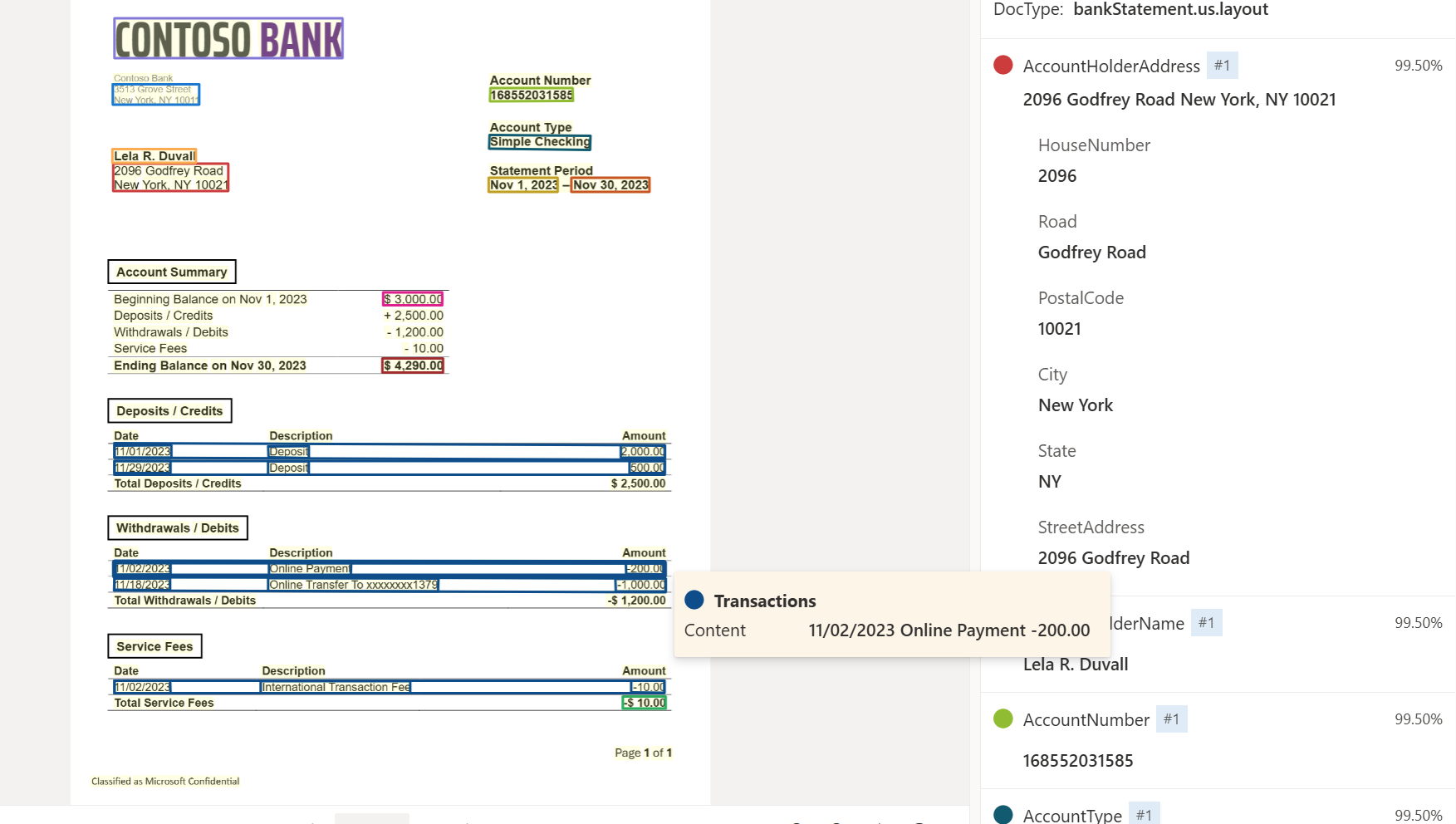
The same applies to bank statements and other financial records. Tables need to be reconstructed so that dates, descriptions, deposits, withdrawals, and balances stay associated with the correct transaction.
For scanned or image-based files, OCR mortgage documents is another important part of the process. OCR converts the visible text into machine-readable content, but extraction does not end there. The resulting text still needs to be mapped to the right fields and checked against the document structure.
Narrative documents: find information in context
Some mortgage documents do not follow a fixed field structure at all. An appraisal report, for example, can contain paragraphs describing the property, tables with comparable sales, valuation figures, and observations from the appraiser.
Here, the system needs to identify relevant information from the surrounding context. It may need to extract the property address, appraised value, square footage, property condition, comparable properties, and other details from different sections of the same report.
This type of processing relies more heavily on language understanding than a standard form does. The same information can also be expressed in different ways, so matching a predefined field to an exact phrase is not always enough.
Give every extracted field a confidence score
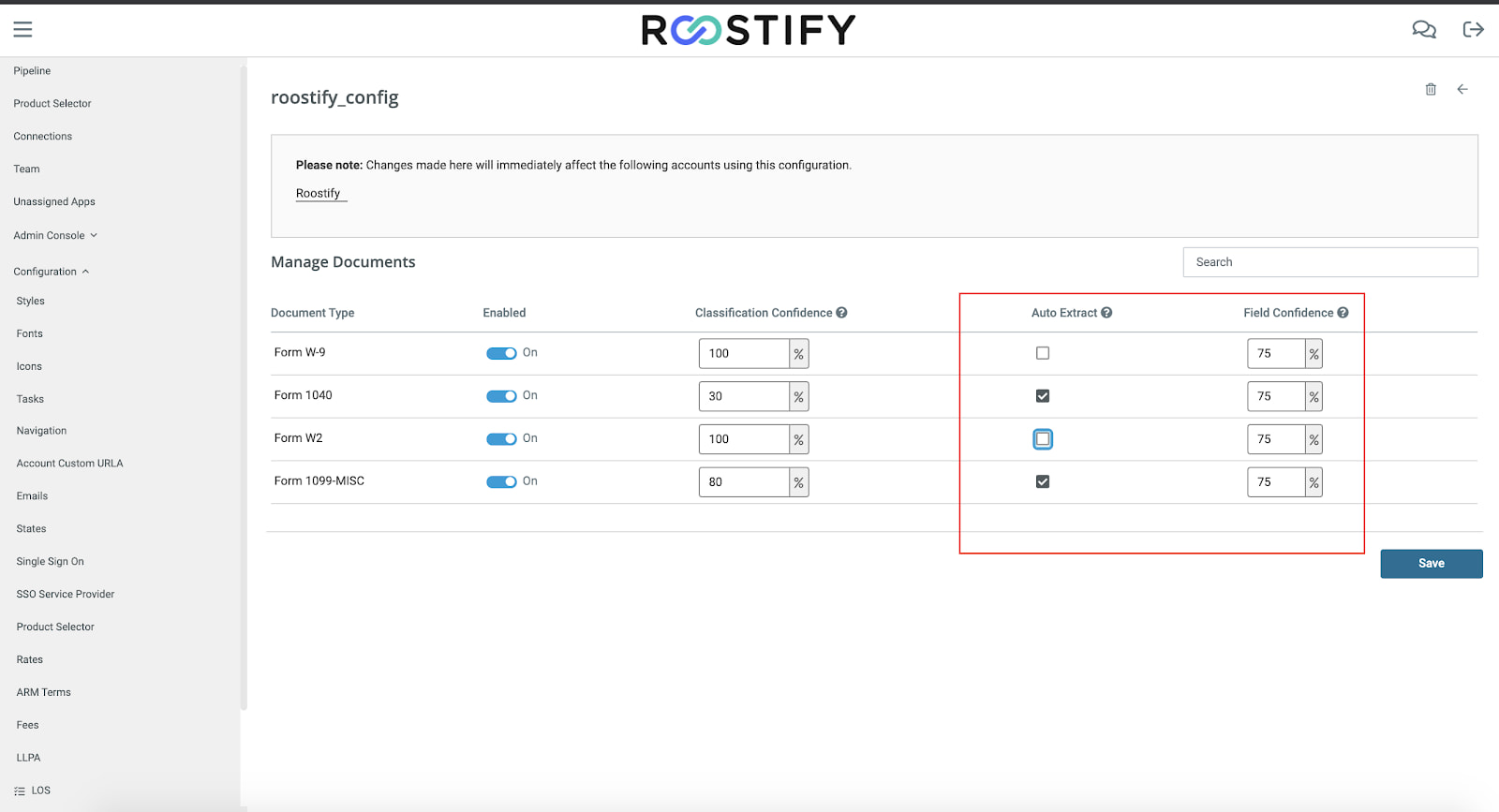
Extraction should not be treated as an all-or-nothing process. Each field can receive its own confidence score based on factors such as document quality, OCR accuracy, field location, format consistency, and how clearly the value matches the expected information.
For example:
| Extracted field | Value | Confidence |
|---|---|---|
| Borrower name | John Robert Smith | 99% |
| Annual income | $85,000 | 97% |
| Bank balance | $42,180.25 | 94% |
| Property address | 125 Main Street | 98% |
| Appraised value | $475,000 | 91% |
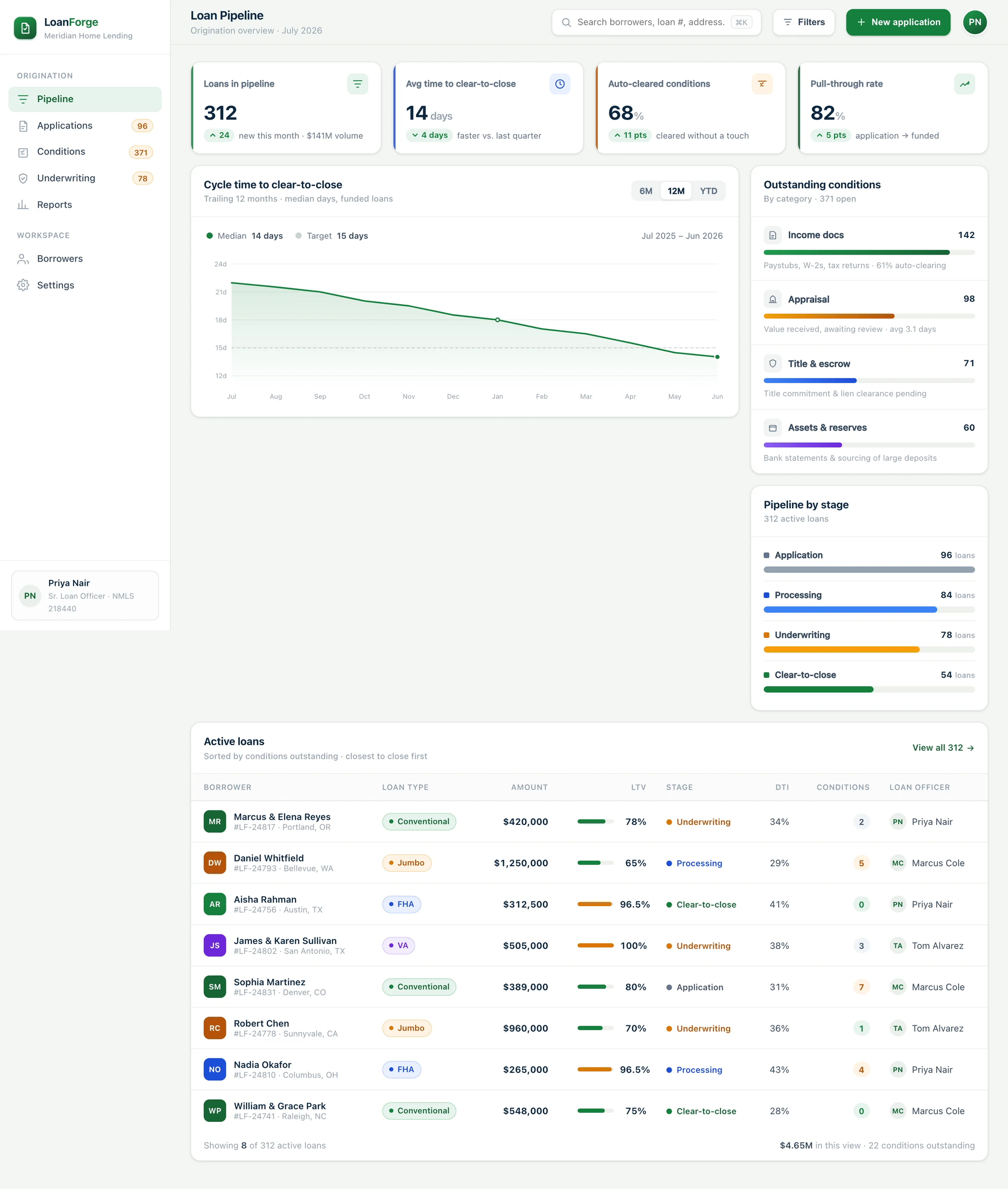
A high-confidence value can move through the workflow automatically, while a lower-confidence result can be sent for review. This gives underwriters a way to focus their attention on uncertain information instead of checking every extracted field manually.
Entity resolution: matching “John R. Smith” to “John Robert Smith” to “J. Smith”
Extracting a borrower’s name from a mortgage document is only the first step. The harder question is whether “John R. Smith,” “John Robert Smith,” and “J. Smith” refer to the same person.
The same problem appears with employers and properties. One document might list ABC Construction LLC, another ABC Construction, and a third ABC Construction, LLC.
Property addresses can vary just as much. Differences in abbreviations, apartment numbers, ZIP codes, or formatting can make the same address look like several different ones.
Entity resolution in mortgage workflows compares normalized names, employer details, and property addresses using multiple matching signals, such as abbreviations, spelling variations, word order, and formatting differences.
For names, these can include middle-name initials, common abbreviations, word order, and spelling variations. For employers, the system can compare normalized company names and known variations.
Addresses can be standardized too. For example, St. and Street can be treated as the same value, while apartment numbers, ZIP codes, and directional abbreviations can be separated and compared individually.
A fuzzy matching model can then assign a confidence score to a potential match. Lile that, the entity resolution mortgage process gets a way to distinguish likely matches from cases that need a closer look.
High-confidence matches can be automatically reconciled and borderline matches can be sent for human review.
The threshold depends on the risk of getting the match wrong because matching two versions of the same property address may tolerate a different threshold than matching two borrowers with similar names.
This identity verification mortgage approach helps prevent harmless formatting differences from becoming unnecessary exceptions. It fits into the broader use of AI for mortgage document processing and automated data extraction, which we cover in our guide to AI in mortgage operations.
At the same time, it does not force every match through automation. High-confidence cases move forward automatically, while ambiguous cases are surfaced for a human to make the final call.
Income Reconciliation: The Highest-stakes Cross-check
Income verification AI for mortgages needs to compare figures across pay stubs, W-2s, tax returns, and bank statements while accounting for how and when the income was earned. So it's not just pulling the salary slip.
Before comparing the numbers, the system should normalize:
- Pay frequency: convert weekly, biweekly, or monthly income into a common annual figure.
- Gross vs. net: keep gross earnings separate from take-home pay.
- Income type: apply different rules to W-2 wages and self-employment income.
- YTD figures: compare year-to-date earnings against the correct pay period, rather than treating them as annual income.
Not every income verification discrepancy needs manual investigation. Rounding differences, payment timing, or slightly different YTD periods can explain small variations. A mismatched employer, unexplained income spike, or figure that does not align with the stated pay frequency is more likely to require review.
A 2026 case study from Autyn reports that its AI income extraction workflow processed full borrower packages in 1–3 minutes, compared with 1–2 hours manually, with 94–98% field-level accuracy across more than 3,000 mortgage documents. The system also assigns confidence scores so low-confidence fields can be routed to human review.
The goal is simple: reconcile routine differences automatically and send meaningful discrepancies to the underwriter instead of making them check every figure manually.
Discrepancy Classification: Routine vs Flag vs Reject
Finding conflicting information is only the first step. A mortgage reconciliation system also needs to decide what each discrepancy means and what should happen next. A small difference between two documents may be perfectly explainable, while a larger mismatch may need an underwriter’s attention.
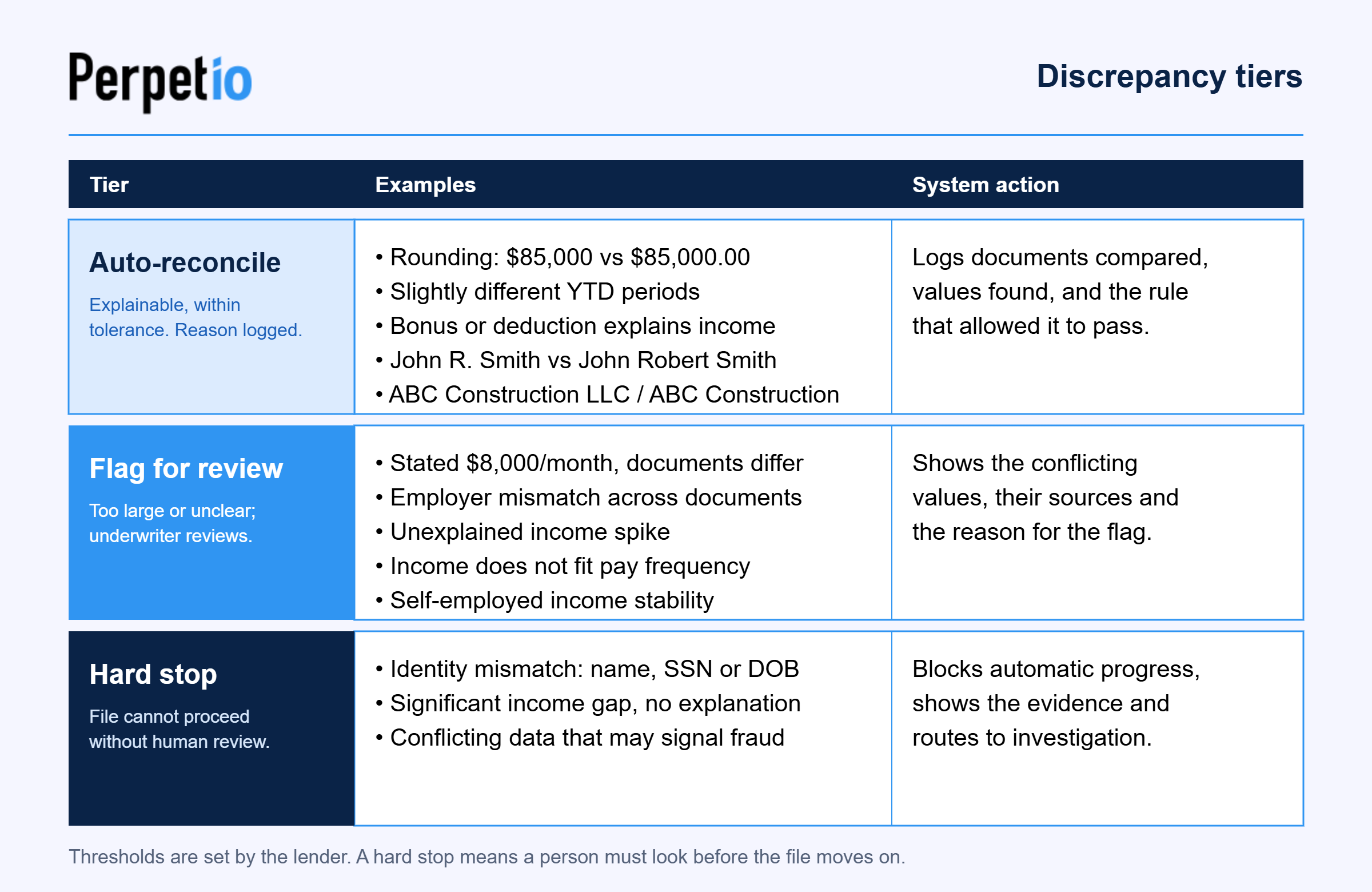
Mortgage discrepancy detection AI can help classify inconsistencies based on predefined rules, thresholds, and the context of the documents involved. Instead of treating every mismatch as a problem, the system can route each case to one of three outcomes: auto-reconciled, flagged for review, or stopped for investigation.
Auto-reconciled: explainable differences
Not every discrepancy needs human review. Dates can differ because documents were issued at different times, income figures can vary because of bonuses or deductions, and account balances can change between a bank statement and a more recent document.
If the system can explain the difference and it falls within an approved tolerance, it can mark the discrepancy as reconciled. For example, a small difference between the income reported on a pay stub and the figure extracted from an employment document may be acceptable if it matches the lender’s reconciliation rules.
The important part is that the system should not simply ignore the difference. It should record why it was considered acceptable, which documents were compared, what values were found, and which rule allowed the case to pass.
Flagged for review: something doesn’t add up
Some discrepancies are too significant or unclear to resolve automatically. If the difference exceeds a defined threshold or the system cannot find a reasonable explanation, the file can be flagged for an underwriter.
For example, the borrower’s stated income may be $8,000 per month while supporting documents consistently show a significantly different amount. A conflicting data detection AI system can identify the mismatch, compare it against the relevant documents, and send the case for review instead of making the final decision itself.
The reviewer can then see the conflicting values, their sources, and the reason the system flagged them. This gives the underwriter a starting point instead of forcing them to search through the entire mortgage file manually.
Hard stop: discrepancies that need investigation
Some inconsistencies should prevent the file from moving forward automatically. An identity mismatch between the application and supporting documents, for example, may require immediate investigation. The same applies to significant income inconsistencies that cannot be explained by normal variations and may indicate potential fraud.
A hard stop does not have to mean that fraud has been confirmed. It means the discrepancy is serious enough that the system should not allow the file to proceed without human review.
This distinction matters because automated mortgage discrepancy detection should support underwriting decisions, not make unsupported accusations. The system can identify the pattern, show the evidence behind the alert, and route the case to the right person for investigation.
The Human Review Layer: What AI Always Escalates
AI can extract documents, compare figures, and identify inconsistencies, but some mortgage cases still need human judgment. A practical AI loan underwriting compliance workflow defines clear escalation rules instead of letting the model decide when a case is safe to move forward.
| Case | What AI can do | Human review |
|---|---|---|
| Identity discrepancy | Compare names, SSNs, dates of birth, and other identifying fields across documents | Determine why the information conflicts and whether the file can proceed |
| Significant income variance | Compare income figures and apply lender-defined tolerance thresholds | Review discrepancies that exceed the threshold or cannot be explained |
| Self-employed income | Extract tax data, calculate figures, and organize supporting documents | Review income stability, business performance, and qualifying income |
| Potential fraud indicator | Identify unusual patterns or conflicting information | Investigate the evidence and make the final determination |
Self-employed income needs more context
Self-employed borrowers are a good example of where automation can prepare the analysis without replacing the underwriter.
Fannie Mae defines a borrower with 25% or more ownership in a business as self-employed and generally requires lenders to obtain a two-year history of prior earnings. The lender must also analyze the stability of the income and retain a written analysis or approved automated findings report in the loan file.
AI can extract figures from tax returns, identify changes between years, and organize the relevant schedules. The underwriter still needs to assess whether the income is stable and can be relied on for the mortgage.
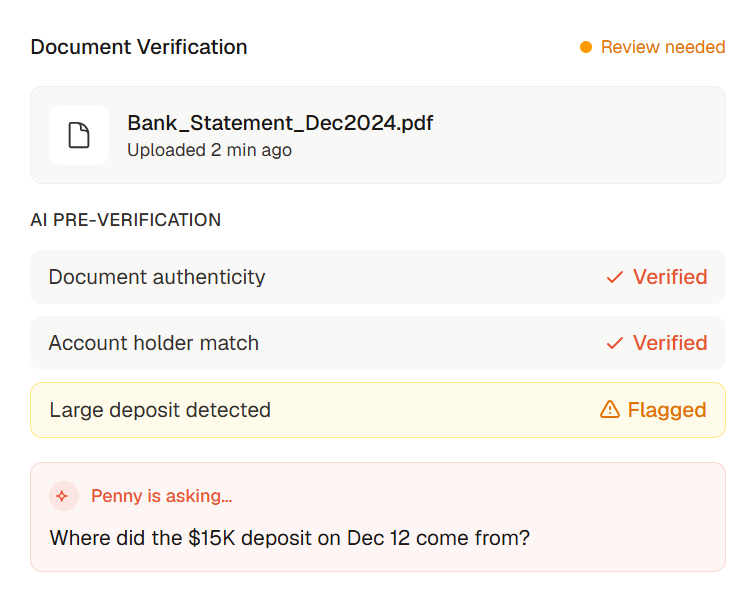
Build the audit trail into the workflow
Every escalation should leave a clear record of what happened:
- documents and fields used
- extracted values
- rules or thresholds applied
- reason for escalation
- reviewer’s decision and notes
- timestamps for each action
This is especially important when AI contributes to a credit decision. The CFPB has stated that lenders using complex algorithms still need to provide specific and accurate reasons for adverse actions. There is no exception simply because AI was involved.
Fannie Mae's current quality control requirements also call for lenders to verify the accuracy and integrity of the information supporting underwriting decisions, including underwriting documents, data, and outputs from third-party analysis tools.
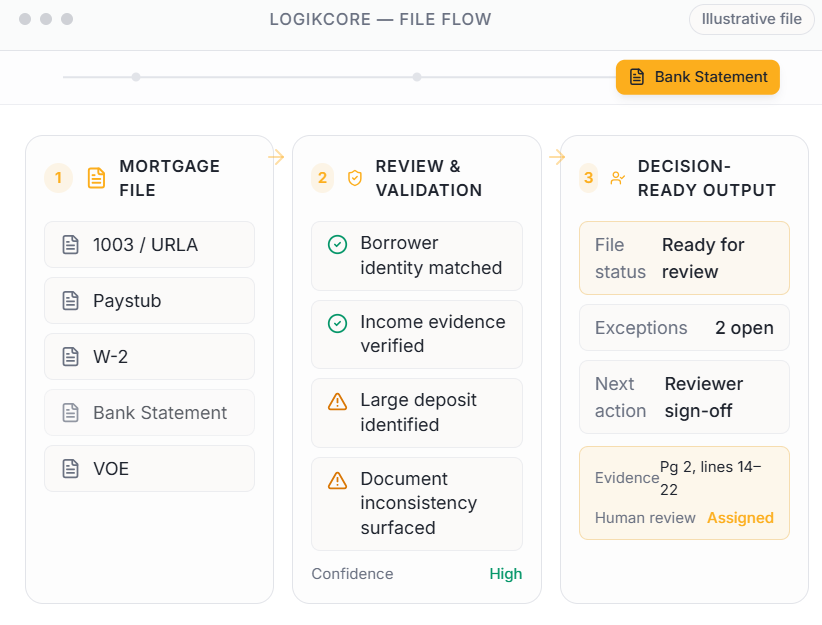
So the audit log should say more than “AI flagged the application.” It should show what conflicted, which rule was triggered, and what the human reviewer decided.
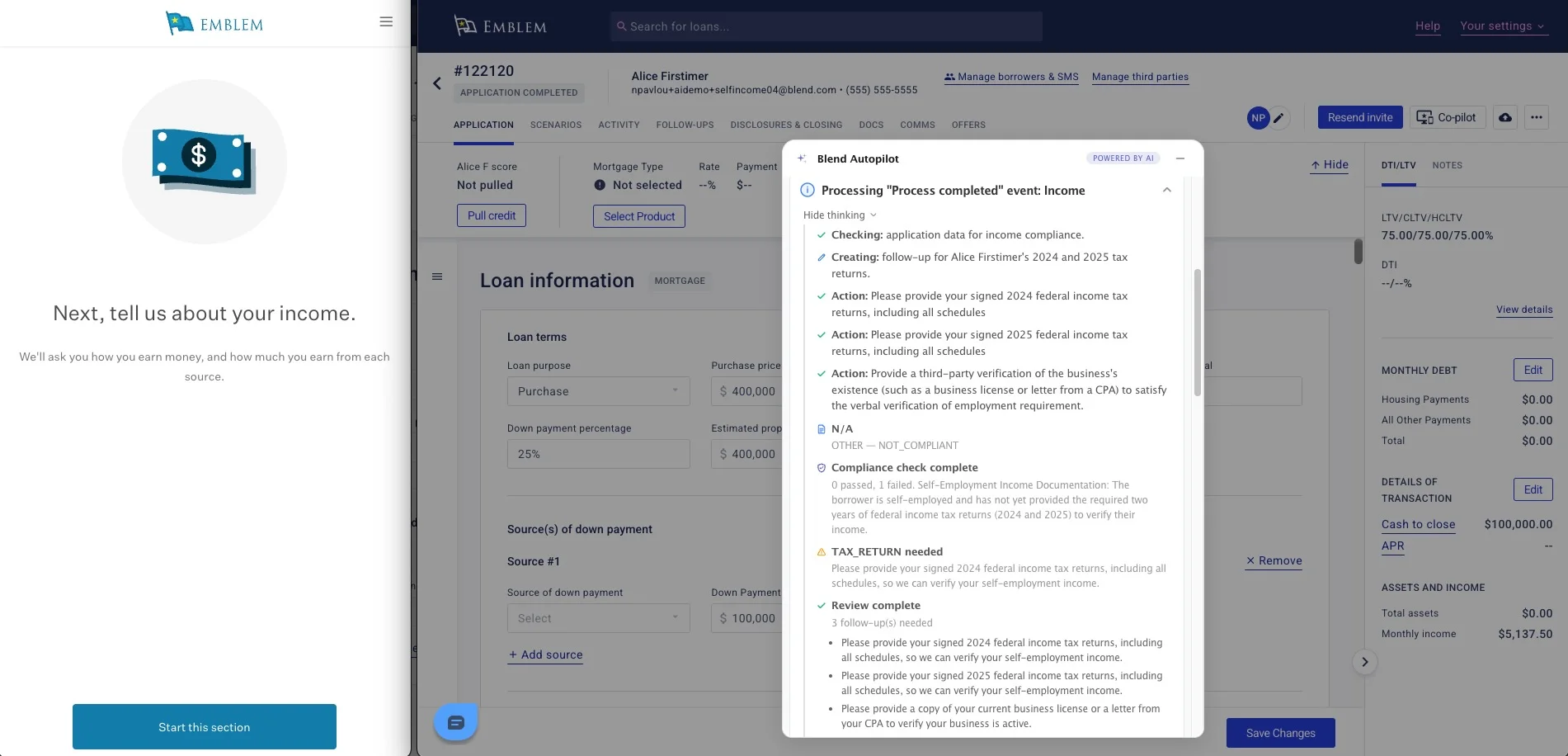
The goal is simple: let AI handle the repetitive comparison and evidence gathering, while humans stay responsible for cases that require context, investigation, or judgment.
Build Mortgage AI with Compliance in Mind
Mortgage automation needs more than accurate document extraction. It needs clear rules, human review points, and an audit trail that shows how every decision was reached.
As a fintech AI development company, Perpetio builds document AI solutions for regulated workflows, including mortgage AI software development. We design extraction, reconciliation, escalation, and audit logging into the system from the start, so automation can speed up underwriting without turning the process into a black box.
Maybe it's your sign to talk to Perpetio about adding AI's efficiency to your mortgage workflow?