A utility crew comes back from the field with hundreds of photos, a stack of technician notes, and a few assets that “looked a little off.”
Then what?
Someone has to review the photos. Someone else has to read the notes. An asset manager checks the maintenance history. Eventually, someone decides which assets need attention first.
That process becomes difficult when inspections pile up faster than teams can review them. A damaged component may be visible in a photo while the reason it matters is buried in a technician’s note or an old maintenance record.
An AI utility field inspection system can connect those pieces. The same data can support AI predictive maintenance utilities, helping teams identify potential defects, assess asset condition, and prioritize follow-up work.
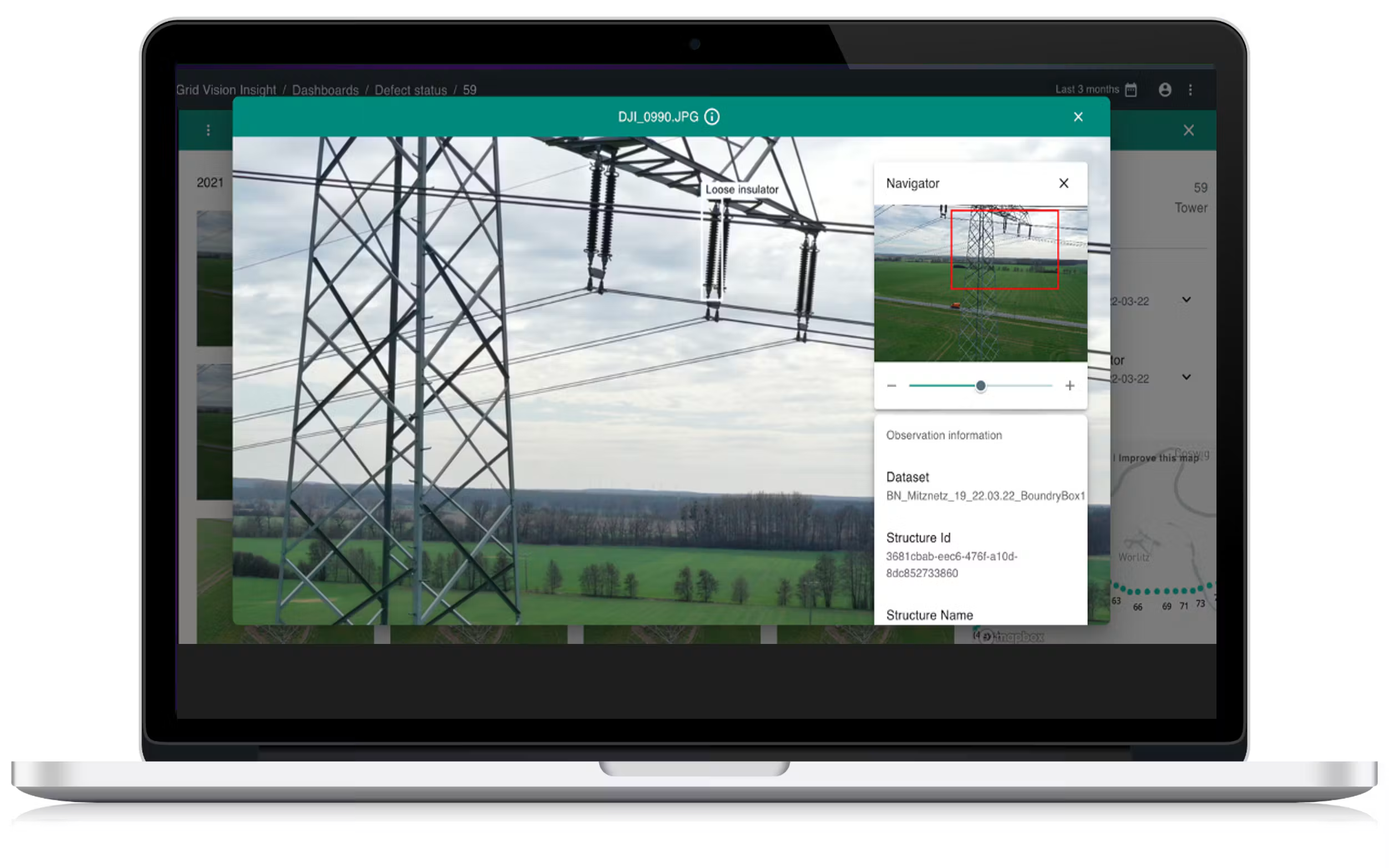
Infrastructure inspection AI photos can flag what deserves a closer look, while technician notes and asset history add the context that an image alone cannot provide.
The goal is not to replace inspectors. It is to make the information they collect easier to review, compare, and act on.
What the system needs to process and why it's hard
A field inspection rarely produces one clean dataset. It produces a mixture of photos, free text, asset records, and maintenance knowledge, often stored in different systems and written for different purposes.
For infrastructure inspection AI, that creates a bigger challenge than teaching a model to spot a cracked insulator or corroded component. The system needs to understand what it is looking at, identify which asset the finding belongs to, and put that observation into the context of the asset's condition and maintenance history.
There are four main inputs.
Field photos
Photos are usually the richest source of visual evidence, but they are rarely consistent. One technician may take a close-up of a component in good daylight. Another may photograph the entire pole from the road. Images can be blurred, poorly lit, partially obstructed, or taken from angles that make a defect difficult to judge.
Real utility inspections show how much this can matter in practice. In an EPRI demonstration of automated visual line inspections, San Diego Gas & Electric used a drone to inspect 20 poles in a canyon with limited access. The flight took about three hours, compared with an estimated two days for a crew to inspect the same area on foot. The inspection also identified enough damaged equipment to support deenergizing the line after its load was transferred to other circuits.
That means infrastructure inspection AI needs to handle more than a neat collection of standardized images. It needs to work with the messy conditions in which field inspections actually happen.
Technician free text
The second input is harder to standardize: technician notes.
A note might say:
“Minor rust on crossarm. Hardware looks loose. Monitor.”
Another technician might describe the same situation as:
“Corrosion around bracket, slight movement. Check next visit.”
The meaning is similar, but the vocabulary is different. Add abbreviations, shorthand, incomplete sentences, and company-specific terminology, and a simple keyword search quickly reaches its limits.
What can help is technician notes AI analysis. An NLP system can extract details such as the component mentioned, observed condition, severity, recommended action, and whether the technician expects follow-up.
| Field | Extracted value |
|---|---|
| Component | Crossarm |
| Condition | Rust / loose hardware |
| Severity | Minor |
| Recommended action | Monitor |
| Follow-up | Next inspection |
The original note should remain available alongside the extracted information. The AI output supports the inspector's observation rather than replacing it.
Asset history
A photo or technician note rarely tells the whole story.
Suppose a technician reports corrosion on a transformer enclosure. On its own, that may look like a routine maintenance issue. The asset record could tell a different story: the transformer has already had two repairs, showed abnormal temperature readings last year, and is approaching the end of its expected service life.
Asset history can include installation dates, previous inspections, repairs, component replacements, sensor readings, failure records, and maintenance schedules. The problem is that this information often sits across asset management platforms, maintenance systems, spreadsheets, GIS databases, and older internal tools.
A field inspection system needs more than a computer vision model. The model might identify corrosion in a new photo, but the application also needs to know which asset was photographed, what has happened to it before, and where that finding should go next.
EPRI's work on automated visual line inspections illustrates why connecting these pieces matters. In one demonstration, San Diego Gas & Electric used a drone to inspect 20 poles in a canyon with limited access. The inspection took about three hours compared with an estimated two days for a crew working on foot, and the imagery helped identify damaged equipment that supported a decision to de-energize the line after its load was transferred to other circuits.
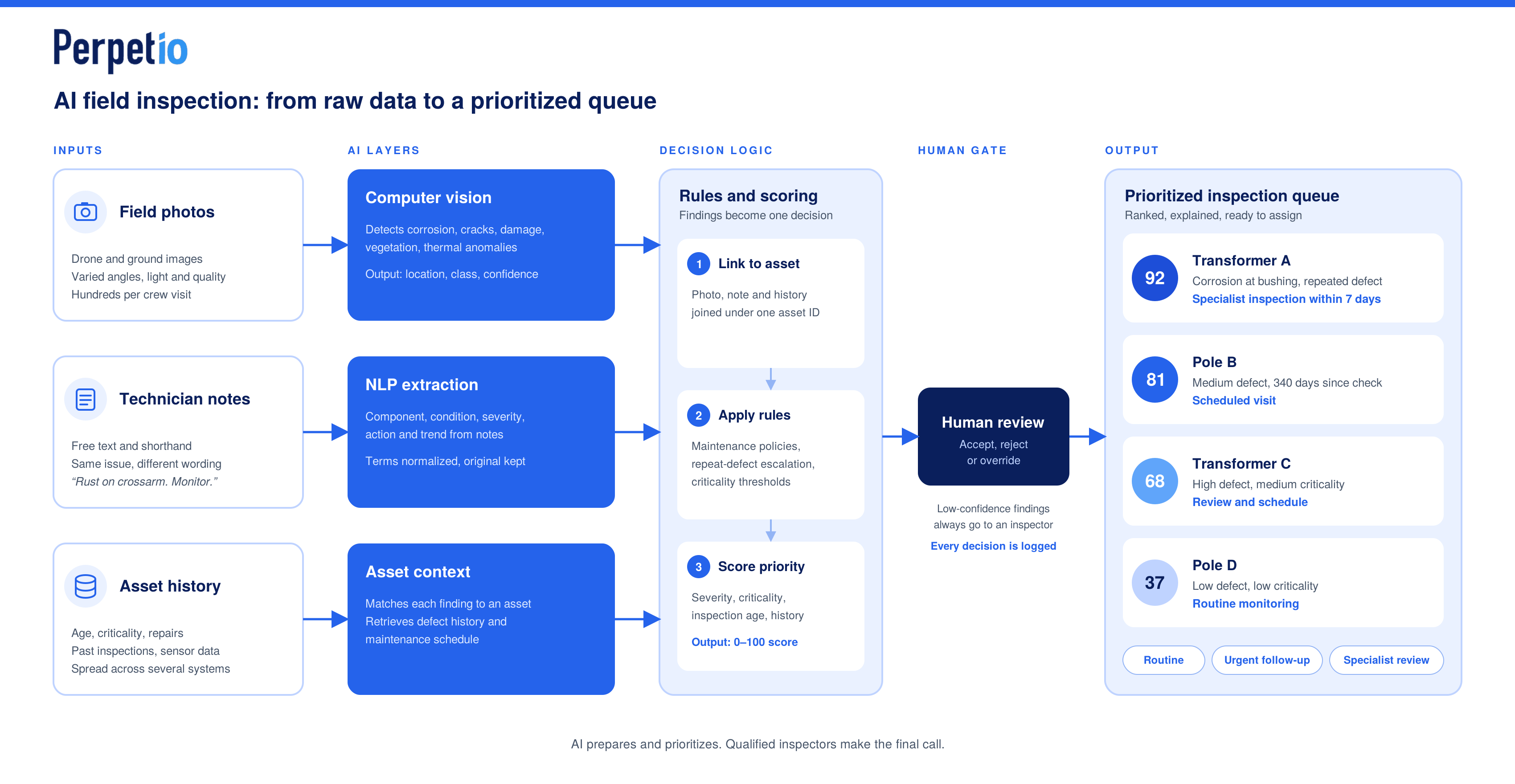
A production system could take this further by connecting image findings to the asset record and maintenance workflow. A detected defect could be linked to previous inspections, repair history, asset criticality, and location, then passed to rules that determine whether the asset needs monitoring, a scheduled visit, or urgent attention.
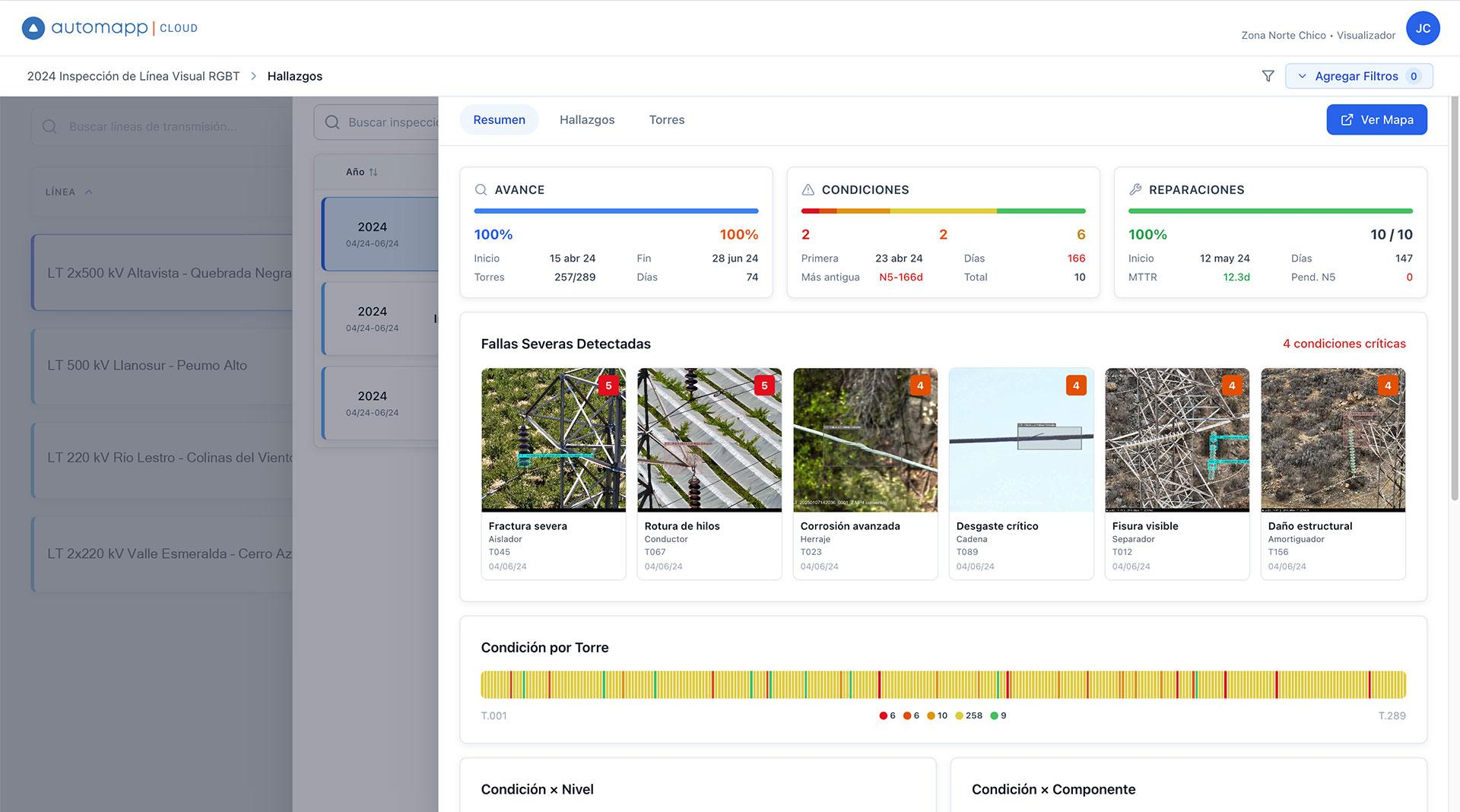
That is a much more useful role for AI in utility inspections. The model handles the parts of the inspection data that are difficult to review at scale, while the software around it connects those findings to the information and workflows the utility already uses.
Maintenance rules and field knowledge
Then there is the knowledge that never made it into a database.
A utility may have formal rules such as:
- Replace a component when corrosion reaches a defined severity.
- Inspect an asset more frequently after a certain type of defect.
- Escalate findings on critical transmission equipment.
- Combine several minor findings when they occur on the same asset.
Experienced technicians also work with less formal knowledge. They know that a particular combination of symptoms deserves a closer inspection. They know which defects tend to appear together. They know that the same finding can mean something very different on a 30-year-old asset than on equipment installed last year.
A useful system needs to account for both. Formal requirements can become explicit logic in a rules engine, while historical inspection and maintenance data can provide additional context.
EPRI's AI for Power research illustrates this broader approach. Its work on asset inspection and prioritization considers image findings alongside factors such as defect severity, failure probability, and asset criticality.
That is why the architecture matters. The system is not simply looking at a photo and predicting “defect” or “no defect.” It needs to connect what was seen, what was written, which asset was inspected, what happened to that asset before, and what the utility normally does when similar conditions appear.
Once those pieces are connected, inspection data can become useful input for maintenance decisions instead of another batch of files waiting for someone to review them.
Defect identification from photos: what computer vision can and can't do
A field photo can contain a lot of useful information, but a model still has to interpret what it sees. Infrastructure inspection AI photos can help identify visible defects at scale, while AI defect detection photos can turn thousands of images into a much more manageable list of assets that deserve human attention.
The important word is visible. Computer vision works best when the defect has a recognizable visual pattern and the image contains enough information to judge it.
What computer vision can identify
With the right training data and inspection requirements, a vision model can be trained to recognize specific conditions such as:
- Corrosion: identify visible corrosion and, where image quality allows, estimate its location, type, or extent.
- Cracks: detect visible cracks and measure characteristics such as approximate length or width when there is a suitable reference scale.
- Vegetation encroachment: identify vegetation that has entered a defined clearance zone around utility infrastructure.
- Physical damage: flag broken, bent, missing, or visibly displaced components.
- Thermal anomalies: with thermal imagery, identify unusual temperature patterns that may require further investigation.
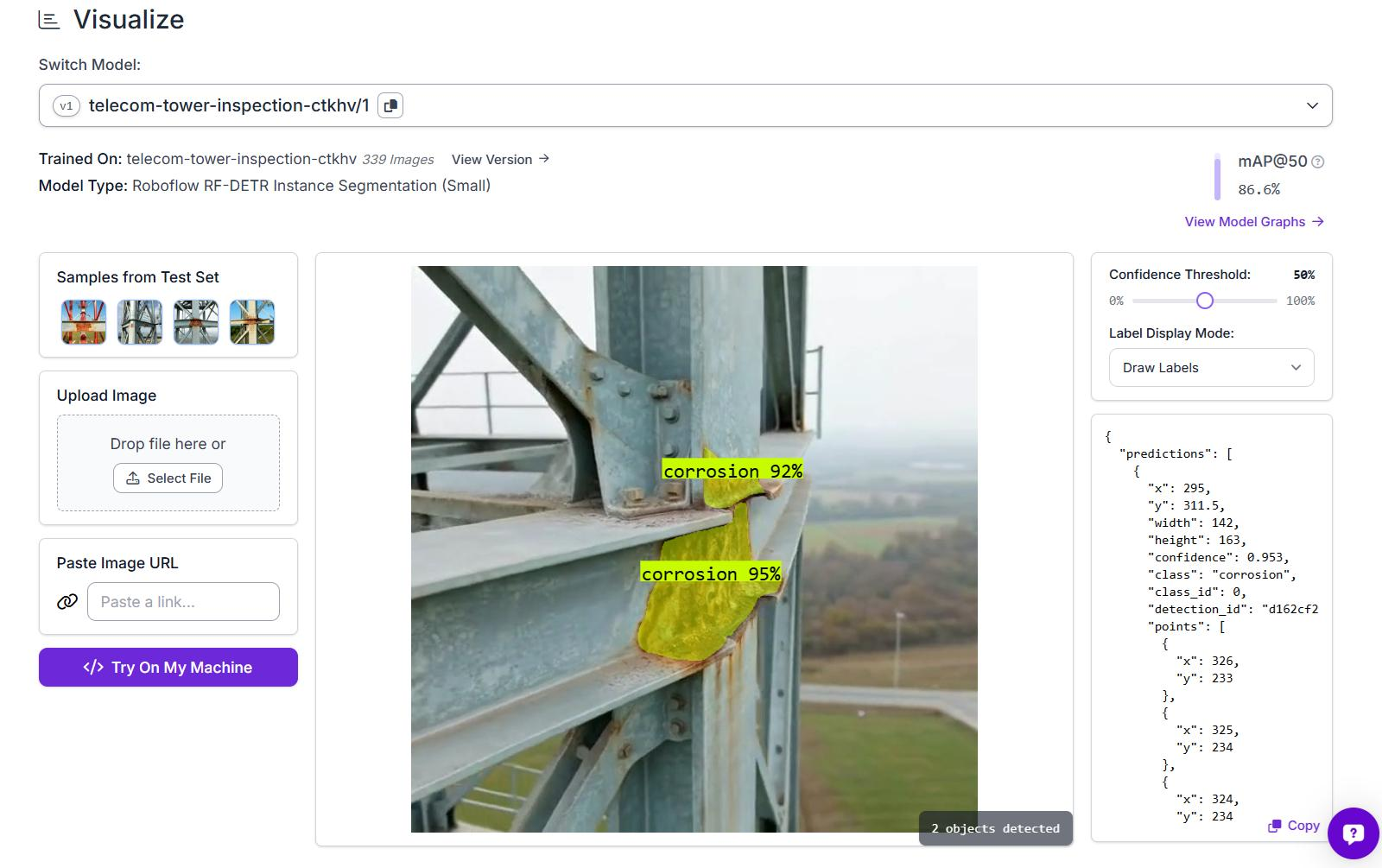
The model does not necessarily need to make the final maintenance decision. A more useful approach is to have it mark the relevant area, classify the potential issue, attach a confidence score, and send the result to a human reviewer or a rules engine.
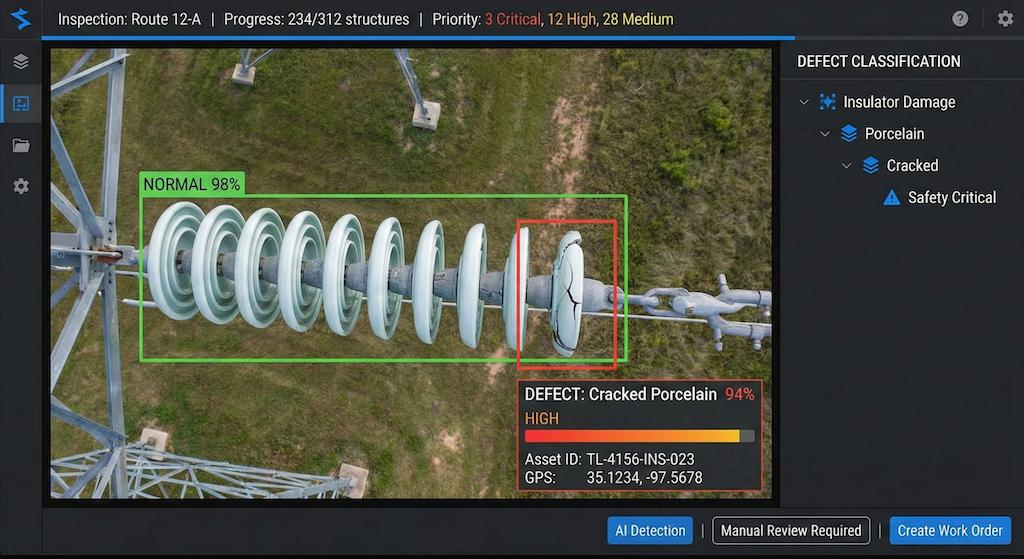
Perpetio's AI app development services include image recognition, object detection, custom AI models, and predictive analytics. For a utility inspection product, these capabilities can sit inside a workflow that connects the image finding to the asset record and the next action.
Where the model starts to struggle
Not every defect has a clean visual signature.
A photo may show a component that looks damaged, but the model cannot always determine whether the damage is superficial or a sign of an imminent failure. A shadow can look like a crack. Dirt can look like corrosion. A bent component can be difficult to distinguish from one that was installed at an unusual angle.
Poor imagery creates another problem. A blurry photo, extreme distance, glare, darkness, heavy rain, or an obstructed component can remove exactly the visual information the model needs.
Novel failure modes are even harder. If the training data contains thousands of examples of corrosion but almost none of a particular type of mechanical failure, the model has little basis for recognizing that new condition reliably.
That is why a production system should not treat every model prediction as a fact. Low confidence results can be routed for human review, while clearly recognizable findings can move further through the workflow automatically.
The training data matters as much as the model
A generic computer vision model is unlikely to understand the difference between the components and defects that matter to a particular utility.
Training data needs to reflect the actual equipment, camera types, inspection conditions, terminology, and defect categories the system will encounter. Images also need reliable labels. If one reviewer calls a condition “minor corrosion” and another calls the same condition “surface rust,” the model is being trained on inconsistent definitions.
This is one reason an inspection AI project should start with a clearly defined defect taxonomy and a representative image set before choosing the final model architecture.
Perpetio can support this part of the process through custom AI development, including custom models and AI feature integration. The goal is not to add computer vision because it sounds impressive. It is to train and integrate a model around the actual inspection decisions the utility needs to make.
The safest output is not “repair this asset”
A useful inspection system should separate observation from decision.
For example:
Photo: visible corrosion around a connector
Model finding: corrosion detected
Confidence: 91%
Suggested severity: moderate
Human review: required
Asset history: previous corrosion finding 14 months ago
Rule: escalate repeated corrosion on this component
That gives the maintenance team evidence to work with without pretending that a photograph can tell the entire story.
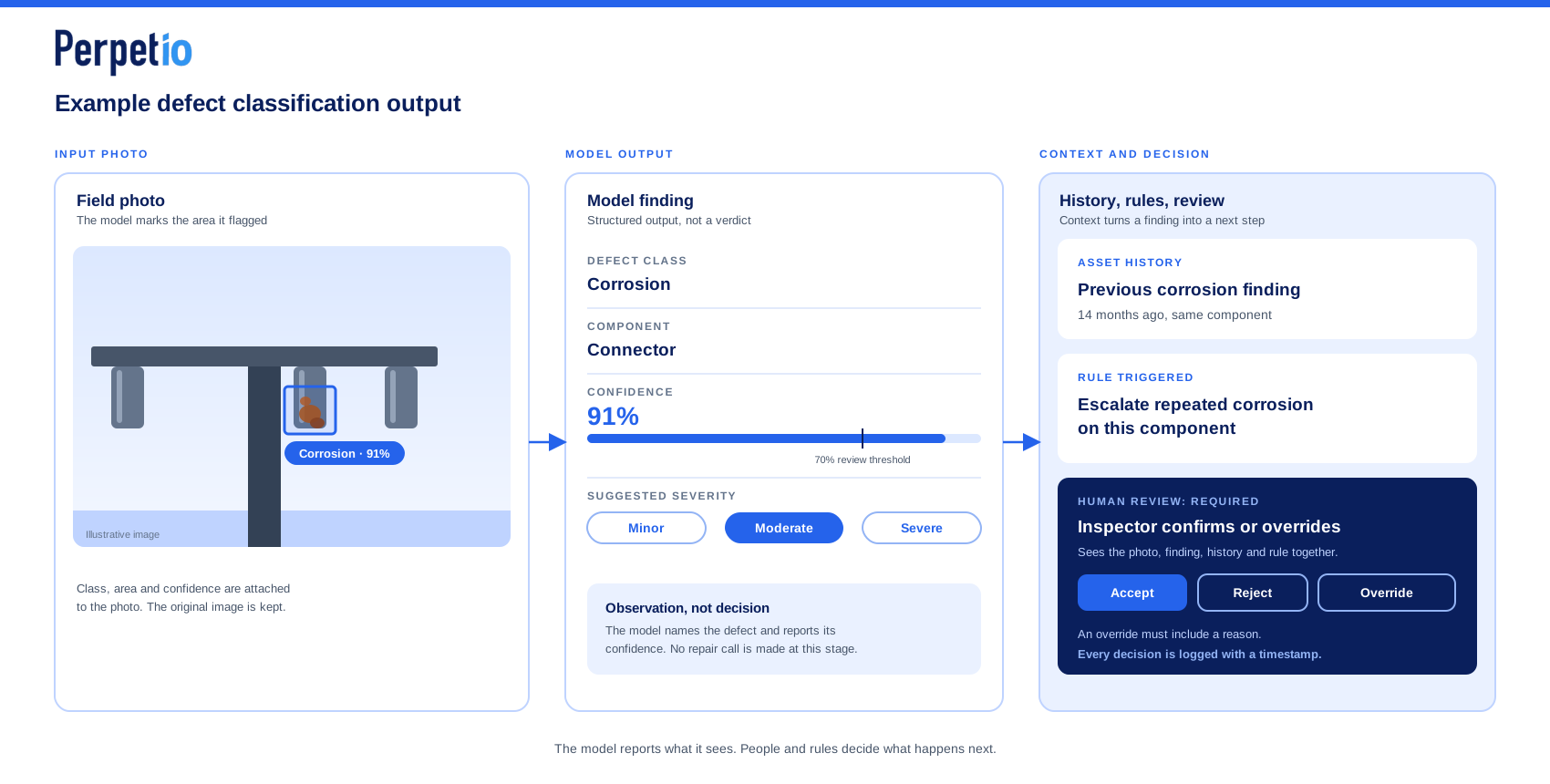
This distinction is especially important in infrastructure. AI can help review imagery, surface potential defects, and organize inspection findings. It should not independently decide that an asset is safe, unsafe, or ready for a critical maintenance action.
The strongest AI defect detection photos workflow therefore ends with a reviewable finding and a clear next step, not an unexplained prediction.
For utilities building this kind of system, the computer vision model is only one component. The surrounding product still needs image storage, asset matching, confidence handling, human review, business rules, audit trails, and integration with existing maintenance workflows. Perpetio's AI automation services can help connect these AI outputs to the workflows where inspection teams actually work.
Technician notes: extracting structured insight from unstructured text
Photos show what an inspector saw. Technician notes often explain what they thought it meant.
The problem is that field notes rarely follow a clean format. One technician might write “rust on lower bracket, monitor,” while another might write “corrosion developing around base, check next visit.” Both describe a similar condition, but a system needs to understand that before it can use the information consistently.
Technician notes AI analysis can turn free text into structured inspection data. An NLP model can extract:
- Defect references: corrosion, cracks, loose hardware, overheating, damage
- Urgency language: monitor, repair soon, immediate attention, unsafe
- Location identifiers: pole number, component name, line section, site reference
- Historical comparisons: “worse than last inspection,” “same issue as previous visit,” or “new since last check”
The next step is normalization. A utility might use “rust,” “surface corrosion,” and “oxidation” in different notes even when they belong to the same defect category. A domain specific vocabulary and entity normalization layer can map those variations to a common structure without losing the original wording.
This approach is similar to how NLP is used in other document heavy workflows. For example, Perpetio's work on AI document processing shows how unstructured information can be extracted and turned into structured data that software can actually use.
For a utility inspection system, the result might look like this:
Original note: “Corrosion around bracket, worse than last visit. Monitor.”
Extracted data: defect: corrosion · location: bracket · trend: worsening · urgency: monitor · historical comparison: negative
That structured output can then be combined with the photo analysis and asset history. A vision model might identify corrosion in the image, while the notes provide the trend and the technician's assessment. Together, they give the maintenance workflow more context than either source could provide alone.
Asset history and maintenance rules: adding context to the observation
Finding a defect is only the first step. The harder question is what that defect means for a particular asset.
Suppose a vision model detects corrosion on a transformer component. For one asset, that might mean “monitor during the next inspection.” For another, it could warrant an urgent site visit. The difference may depend on the asset's age, criticality, previous defects, recent maintenance, and the utility's own maintenance rules.
Asset management AI maintenance rules become extremely useful. The system can cross-reference a new finding with:
- Last inspection: When was the asset last checked?
- Defect history: Has the same issue appeared before, and is it getting worse?
- Asset age and criticality: How important is the asset and how much risk does its failure create?
- Maintenance rules: What action should follow when this type of defect reaches a defined severity?
For example, a utility could define a rule such as: “Corrosion on a grade 3 or higher transmission tower requires a priority inspection within 30 days.” The AI does not invent that requirement. It identifies the relevant condition, retrieves the asset information, and applies the rule consistently.
A real example comes from a Hitachi Digital Services case study. A regulated US utility connected inspection, maintenance, testing, and asset data to assess risk and prioritize mitigation. Within the first 90 days, more than 2,000 transformers were added to the system, and the platform identified a transformer headed for failure, allowing the utility to act before an unexpected outage.
For a field inspection product, the same principle can connect a new image or technician note to the asset's existing history:
Defect detected → asset identified → history retrieved → maintenance rules applied → priority calculated → action recommended
This is the practical role of condition based maintenance AI. It does not need to make the final safety decision. Instead, it gives maintenance teams a consistent way to combine new observations with the information they already have.
This type of predictive system also fits the capabilities Perpetio develops around AI based applications, including predictive analytics and custom AI models. The key is building the surrounding software that connects those models to the utility's existing asset data, rules, and maintenance workflows.
Prioritized inspection queues: from raw data to ordered action list
Once inspection data has been analyzed, the maintenance team still has one practical question: what should we inspect first?
Inspection prioritization AI can combine several signals into a single priority score. A useful model might consider defect severity, asset criticality, time since the last inspection, previous defects, and whether the asset has already triggered a maintenance rule.
For example:
| Asset | Defect severity | Criticality | Days since inspection | Priority score |
|---|---|---|---|---|
| Transformer A | High | High | 210 | 92 |
| Pole B | Medium | High | 340 | 81 |
| Transformer C | High | Medium | 45 | 68 |
| Pole D | Low | Low | 290 | 37 |
The exact formula depends on the utility’s maintenance policies. A critical transformer with a moderate defect may deserve attention before a low criticality asset with a more visible cosmetic issue. That is where maintenance priority scoring AI becomes useful. It gives teams a consistent way to combine signals that would otherwise be reviewed separately.
The output should be more useful than a list of numbers. A maintenance dashboard could show:
Priority 92 — Transformer A
Corrosion detected around bushing
High criticality asset
Last inspection: 210 days ago
Previous corrosion finding: 14 months ago
Recommended action: specialist inspection within 7 days
Reason: repeated defect on a high criticality asset
This format gives the maintenance team enough context to understand why an asset moved to the top of the queue. A supervisor can review the evidence, change the priority if needed, assign the work, and record the final decision.
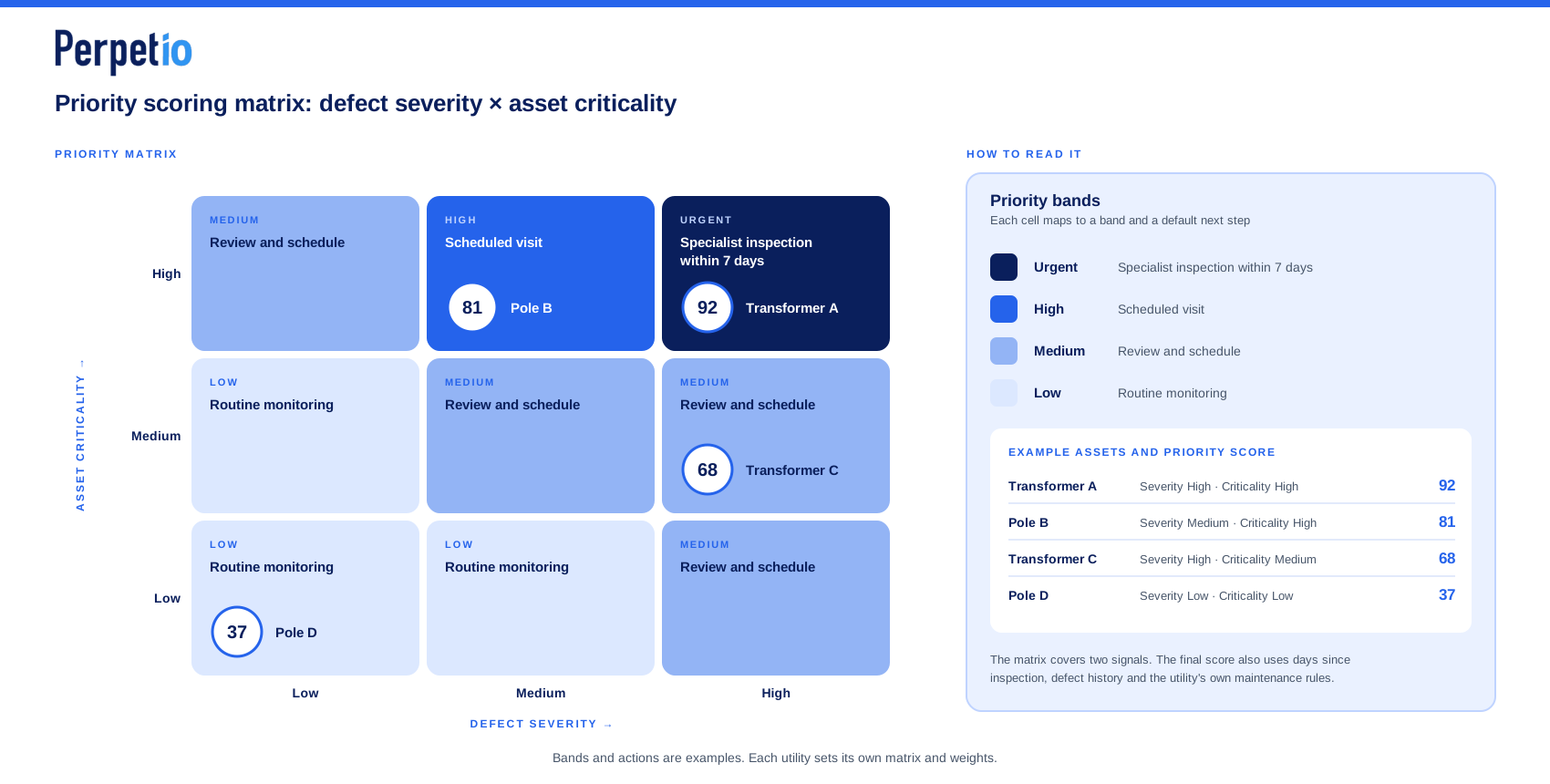
The system can also create different queues for routine inspections, urgent follow ups, specialist review, or manual verification. That makes the AI output part of the existing maintenance workflow rather than another report someone has to open and interpret.
The human-in-the-loop layer: why inspectors remain critical
A high priority score does not mean an asset automatically needs a repair. In a safety critical environment, AI should support the decision, while qualified inspectors and maintenance teams remain responsible for the final call.
The interface should make that responsibility clear. Each AI finding can include a confidence score, the evidence behind the recommendation, and an option for the reviewer to accept, reject, or override it. If a model is uncertain, the system can automatically route the finding for human review instead of treating it as a confirmed defect.
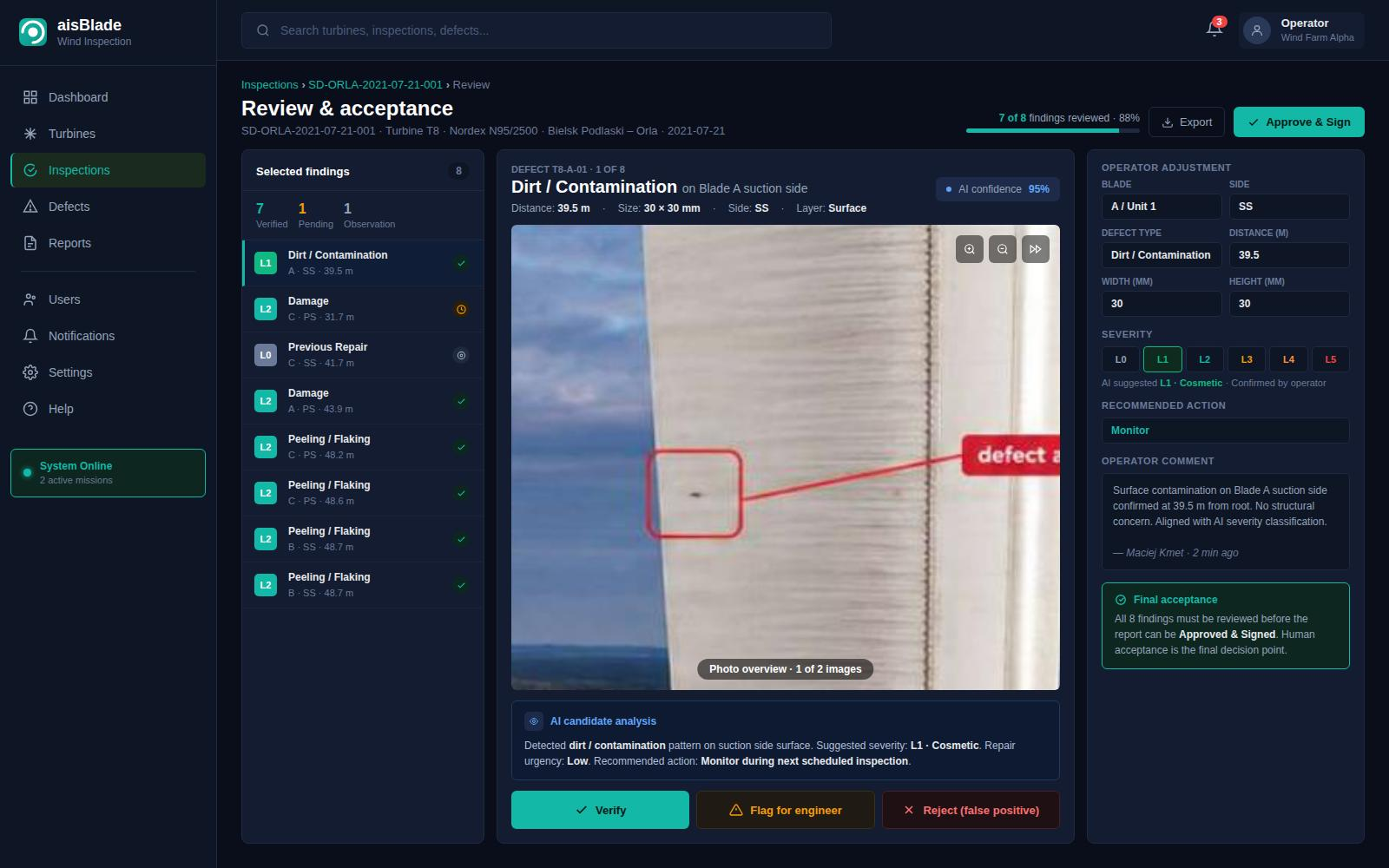
For example, a utility might set rules such as:
- Findings below 70% confidence require manual verification.
- Any suspected structural defect requires inspector review regardless of confidence.
- High criticality assets cannot be automatically cleared by AI.
- An inspector override must include a reason.
These thresholds should reflect the utility’s own risk policies rather than being treated as universal AI settings.
Every decision should also be logged. The record can include the original photo or note, model output, confidence score, recommendation, reviewer decision, override reason, and timestamp. This creates a traceable history of how an inspection decision was made and gives teams useful data for improving the system later.
The result is a workflow where AI handles repetitive analysis and prioritization, while people retain control over decisions that require engineering judgment, field context, or safety responsibility.
Build the inspection system your utility actually needs
Perpetio can help turn inspection photos, technician notes, asset history, and maintenance rules into one AI-powered workflow for detection, prioritization, and human review. Get a free tech consulatation and learn what software does your company need.