If not now, then when?
What used to take years to build can now be done in months, sometimes even weeks. So if you’ve been thinking about launching something of your own, this is a pretty good moment to stop overthinking and start doing.
The entry barrier is lower, the speed is higher, and yes, you can still catch your audience early if you move fast.
As a team that works closely with startups and helps turn ideas into real products from scratch, we’ve seen what actually works in practice. And don’t worry, we are not going to talk about another “build your own ChatGPT” or “AI translator” idea 😅 We have a much more interesting collection in our pocket.
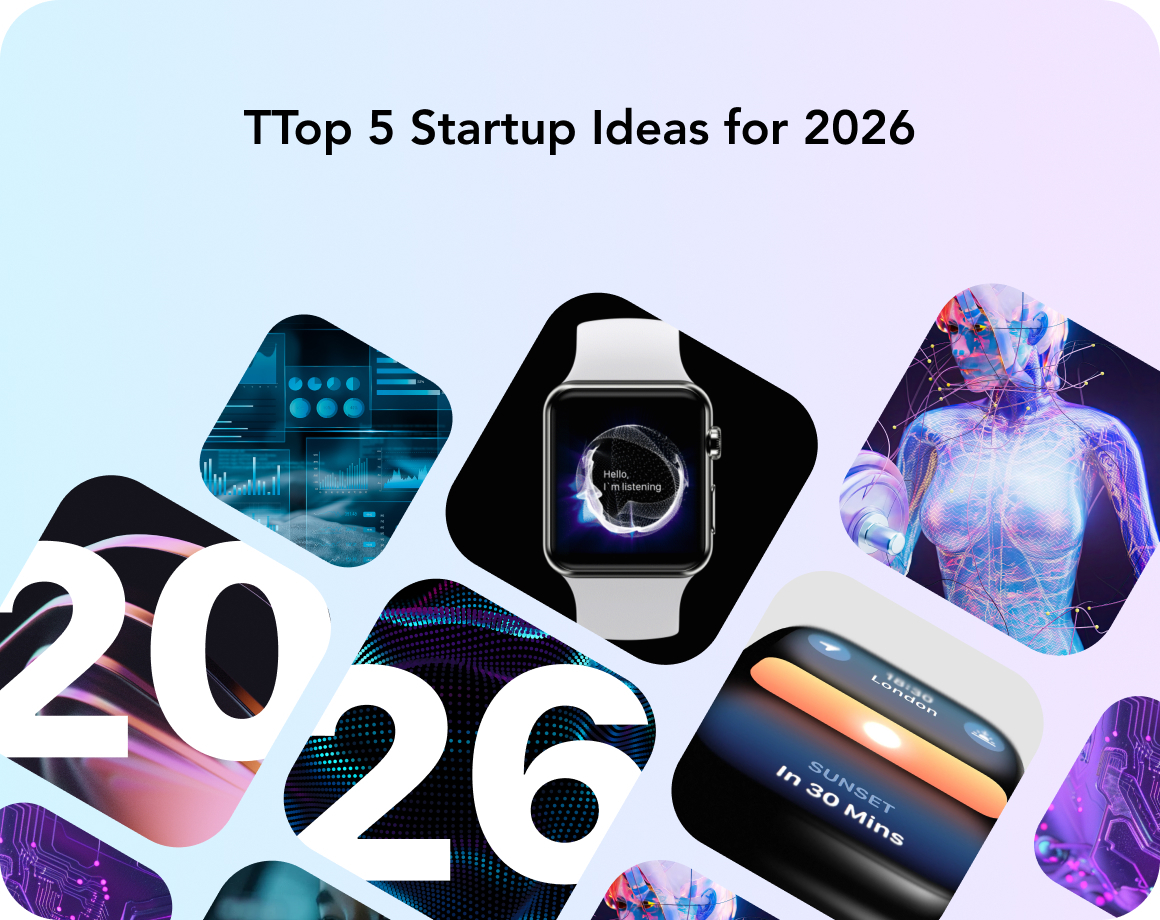
So let’s not overcomplicate things and jump straight into startup ideas that actually make sense for 2026.
1. AI “Second Brain” for Founders
We are not offering you to make another notes app. And definitely not a CRM. There are enough of these on the market already.
Think of it as a place where everything a founder deals with finally makes sense together. Meetings, investor updates, product metrics, and random ideas at 11 pm. Instead of being scattered across tools, it all lives in one place and actually works for you.
The idea is simple. The product tracks what’s going on in your business and helps you see the bigger picture. It can highlight trends in your metrics, show when something feels off, and give small hints on what to focus on next.
For example, it could warn you that your runway is getting tight sooner than expected. Or suggest that it might be the right time to hire based on your growth. It can also put together clean, board-ready updates without you spending hours on slides.
Over time, it starts to notice patterns and udnerstand how a user thinks. So soon enough users get clear, useful insights.
The best part is how you can position this platform on the market. Not as another tool founders have to manage, but as an AI co-founder that helps them make better decisions every day.
2. Digital Twin for Personal Health
Forget step counters and calorie dashboards. That's too simple and there are way too many options existing already. The market is oveersaturated.
What you’re building is a dynamic model of the human body. Think of a digital representation of a person that takes all the health data into account. One that evolves alongside the user, continuously fed by wearables, genetic data, and everyday habits.
The platform simulates how current behaviors translate into future health outcomes, helping users see risks before they become real.
A pattern of poor sleep might reveal its long-term impact on energy or weight. Small lifestyle changes can be tested in advance, showing how different choices could reshape future health.
As the system gathers more data, it becomes increasingly personal. It starts forming a tailored longevity strategy based on real patterns, not generic advice.
The positioning matters here. This is not a health tracker. It’s a premium, preventive health companion designed for the future, with clear potential for partnerships with insurers who value healthier users.
3. AI Trust Layer for the Internet
Right now, the internet runs on assumption. You see something and decide for yourself if it’s real. Yes, we are living in times of extreme fake news flow. Add the generative AI fakes and it's becoming a real challenge to dig out real information online.
This product can change that. It introduces a layer of trust that sits on top of content, adding clarity where there is currently doubt.
Every image, video, or piece of text is verified in real time and assigned an authenticity signal. Deepfakes are detected, AI-generated content is labeled, and potential risks are flagged early.
A viral video might come with a warning about manipulation. An image that looks real could be clearly marked as AI-generated. For brands, this becomes a way to detect and respond to harmful content before it escalates.
Over time, this creates a broader trust system. Influencers can be assessed based on authenticity. Brands gain protection. Users stop guessing.
In the time of synthetic media, there is a clear need for such a tool and a very obvious market gap you can fill in now.
The key is not to present it as a tool people need to actively use and spend time opening the app and checking each post manually. It works best as invisible infrastructure, integrated through extensions or APIs, quietly restoring trust in a space where reality is no longer obvious.
4. AI Back-Office for SMBs
Let's be real here: small business owners don’t need another tool. Each tool means paying for subscription and paying with your time setting up and running each separate platform for accounting, customer service, order management, you name it. That's on top of running the business itself and taking care of the product. What small businesses really need is fewer things to manage, not more.
This is where the concept shifts. Instead of adding software, you introduce an AI layer that takes over operational work behind the scenes.
It connects to the existing stack and handles tasks that usually require constant attention. Invoices, tax preparation, payroll coordination, all managed without daily input.
The value becomes clear in small moments. A subscription cost increases and gets renegotiated automatically. A future cash flow issue is predicted early, giving time to adjust. Vendor contracts are analyzed, revealing hidden inefficiencies.
As the system learns the business, it begins making smarter decisions across operations and finances. Problems are addressed before they appear.
The positioning is straightforward. This is not another SaaS product. It replaces several of them, simplifying operations while reducing both cost and complexity.
5. Skills-to-Income AI Platform
Most platforms focus on learning. Learning a new language, how to code, or become a designer. The problem is that learning alone does not guarantee results.
This product starts from a different place. It begins with income and works backward.
By analyzing market demand in real time, it identifies which skills are actually valuable right now. From there, it builds a path tailored to the user, connecting current abilities to realistic earning opportunities.
Instead of guessing, users can see potential outcomes. One path might lead to faster income, another to higher long-term growth. The platform makes those trade-offs visible.
It might highlight a skill combination that is gaining traction and estimate what it could earn. Or compare multiple directions so users can choose based on their priorities.
As both the market and the user evolve, the roadmap adjusts. What you learn stays aligned with what pays.
Positioning makes all the difference here. This is not a learning platform. It’s an earning platform designed to help people turn skills into income with clarity and speed.
Consider Perpetio Your Trusted Partner
There has never been a better time to launch a startup than now. AI is evolving fast, new tools are appearing every week, and people are more open than ever to trying new technology.
If you start working on your idea this week, you can have an MVP ready very quickly, test it with a real audience, and understand what works and what needs to change. The barrier to entry is lower, but the opportunity is much bigger.
At Perpetio, we see ourselves not just as developers, but as co-creators. Our team helps shape your idea, choose the right technologies, and define a business approach that makes sense from day one. We bring experience from working with over 100 startups, so you avoid common mistakes and move faster with more confidence.
If you have an idea in mind, now is the time to act. Fill in the form and get a free consultation. We will help you understand how to turn your concept into a real product and how to launch it the right way.